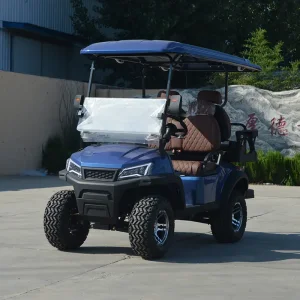
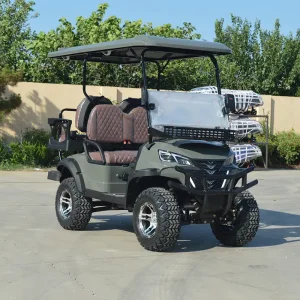
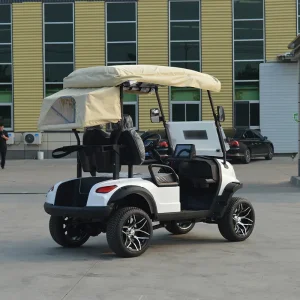
High-Performance Multi-Passenger Fleet Solutions (Part I)
Explore heavy-duty 4-passenger and 6-passenger configurations precision-built for all-day operational cycles, rigorous terrain traversal, resort shuttling, and municipal utility services.
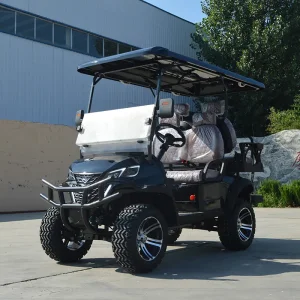


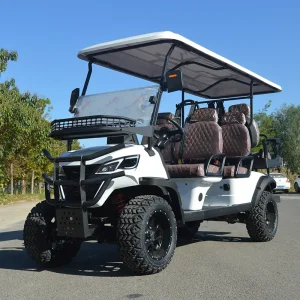
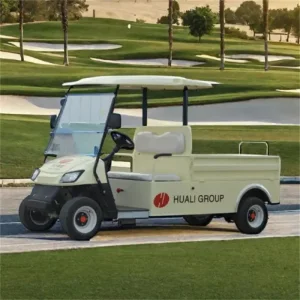
Engineering Architecture & Market Dynamics of 6-Seater Gas Powered Utility Vehicles
In high-intensity commercial environments—such as 36-hole golf resorts, sprawling agricultural sanctuaries, national park concessions, and remote eco-tourism estates—passenger payload capacity and operational uptime are paramount. The 6-seater gas-powered golf cart and high-power commercial buggy segment represents the workhorse tier of global low-speed vehicle (LSV) procurement.
Continuous High-Duty Ergonomics
Unlike 2-passenger runabouts, a 6-passenger vehicle carries an average gross passenger weight exceeding 450 kg (990 lbs). Sourcing from vetted suppliers ensures ladder-frame tubular steel chassis constructed with robotic seam welding, cathodic electrophoretic deposition (E-coating), and hydraulic damping specifically balanced to counteract rear-overhang weight displacement.
Electronic Fuel Injection (EFI) Dynamics
Modern commercial internal combustion golf carts have evolved beyond carburetor configurations. Today's tier-1 manufacturers deploy closed-loop Electronic Fuel Injection (EFI) paired with oxygen sensor monitoring and engine control units (ECUs). This delivers instant cold starts at sub-zero temperatures, eliminates carburetor vapor locks, and maximizes fuel economy under full 6-seat throttle loads.
Severe-Duty Fleet Operational Autonomy
Where centralized charging grids are non-existent or power outages risk immobilizing an entire resort shuttle operation, gas-powered drivetrains allow continuous three-shift operations. Refueling takes less than three minutes, giving operators infinite continuous range and immediate return on investment during peak tourist and guest intake periods.
Why Global Fleet Importers Partner Directly with Chinese Factories
The manufacturing cluster located across Shandong and eastern China encompasses unmatched vertical integration. From precision automated tube bending and robotic welding to dedicated gearbox casting and injection-molded automotive-grade ABS cowls, sourcing directly from verified Chinese industrial manufacturers provides enterprise procurement advantages impossible to match elsewhere.
Zero-Intermediary Tier-1 Sourcing
Procuring straight from the assembly plant strips out 28% to 42% in trading house markup. Importers deal directly with chassis metallurgists and automotive electrical engineers, enabling custom wheelbase adaptations, extended rear deck cargo conversions, customized seat cushioning, and brand livery injection matching.
Bespoke OEM/ODM Tooling Capabilities
Chinese original equipment manufacturers maintain dedicated prototyping CNC milling and rapid composite mold fabrication workshops. Fleet buyers can specify distinct grill fascias, modular roll-over protection structures (ROPS), specialized safari canopy attachments, and dual-purpose split fold-down rear seats in small trial runs before scaling to high-volume containerized procurement.
Standardized Component Interoperability
Modern Chinese golf cart builders deploy universal component engineering: standardizing brake master cylinders, Dana-style transaxles, CVTech continuously variable transmissions (CVT), and heavy-duty front MacPherson strut assemblies. This ensures maintenance teams in the Americas, Europe, Africa, and Australia can source service consumables seamlessly.
Direct Engineering Assurance: When placing fleet orders with premier Chinese golf cart manufacturers, every batch is subject to rigorous dynamic bench testing: dyno testing of engines under variable load, salt-fog corrosion testing of suspension hardware up to 720 hours, and 100% full-weight chassis deflection analysis prior to crating.
Engineering Audit: 6-Passenger Gas Powered vs. 72V Lithium Platforms
Procurement directors must objectively evaluate drivetrain physics based on site topology, ambient temperature extremes, charging infrastructure availability, and maintenance team capabilities. Below is an authoritative technical comparison between heavy-duty commercial configurations.
| Evaluation Parameter | Commercial 6-Seater Gas Powered (EFI) | Commercial 6-Seater 72V Lithium (LiFePO4) | Fleet Strategic Recommendation |
|---|---|---|---|
| Powertrain Architecture | Single/Twin Cylinder 400cc–460cc 4-Stroke OHV with EFI & CVT | 72V 5kW–7.5kW AC Induction / PMSM with 105Ah–210Ah LiFePO4 | Topology Dictated |
| Refueling / Recharging Cycle | 2 to 3 minutes pump refuel (Standard 25L Unleaded) | 3.5 to 6 hours on 220V/110V dedicated charging stations | Gas Wins on 24/7 Multi-Shift |
| Climbing Reserve with 6 Passengers | Continuous mechanical torque through CVT; infinite high-rpm reserve | High initial breakaway torque; thermal limiter activates on extended inclines | Gas Preferred on Mountain Terrains |
| Acoustic & Emission Footprint | 62–68 dB at idle (tuned low-resonance exhaust); EPA Tier 4/CARB exhaust | Virtually 0 dB operating noise; zero localized tailpipe emissions | Electric Preferred Indoors/Quiet Zones |
| Extreme Climate Tolerance | Operates seamlessly from -20°C to +50°C without battery pre-heating | BMS restricts charging below 0°C without integrated internal heating pads | Gas Excels in Desert/Sub-Zero Ops |
| 10-Year Lifecycle Maintenance | Engine oil, spark plugs, drive belts, air & fuel filters every 250h | Virtually zero powertrain maintenance; BMS cell monitoring; pack swap at yr 8–10 | Lithium Has Lower Routine Labor |
Localized Support, Homologation Standards & Safety Compliance
Importing multi-passenger golf carts and LSVs into North America, the European Union, the Middle East, or Australasia requires adherence to strict vehicular and environmental frameworks. Top tier Chinese factories engineer compliance directly into the vehicle architecture, providing factory-certified documentation packages that accelerate customs clearance and local DMV/DOT registrations.
North American EPA & CARB Certification
For gas-powered golf carts, the internal combustion engine must possess valid EPA (Environmental Protection Agency) Tier 4 emissions and CARB (California Air Resources Board) evaporative emissions certification. Sourcing from certified factories ensures fuel systems feature multi-layer low-permeation fuel hoses, sealed carbon canisters, and tamper-resistant EFI calibration maps.
DOT / FMVSS 500 Low-Speed Vehicle Road Legality
Transforming a 6-seater golf cart into a street-legal LSV requires compliance with US Federal Motor Vehicle Safety Standard No. 500. Qualified Chinese manufacturers install DOT-certified AS4 laminated glass windshields with motorized wipers, 3-point retractable safety seatbelts for all 6 passenger positions, illuminated license plate mounts, automotive-grade LED high/low beam headlights, dual turn signal mirrors, and 17-digit VIN stamping.
EU Machinery Directive & EEC L7e Homologation
For European buyers, vehicles carry CE certification under the 2006/42/EC Machinery Directive, accompanied by electromagnetic compatibility (EMC) reports. For public road registration, specialized L7e heavy quadricycle chassis designs incorporate dual-circuit hydraulic four-wheel disc braking, mechanical handbrakes with interlock microswitches, and calibrated speed governors set to 40 km/h or 25 km/h limits.
High-Yield Commercial Applications for 6-Seater Utility Carts
The 6-passenger layout provides the optimal equilibrium between vehicle maneuverability and passenger transit efficiency. Dissect how commercial operations deploy these specialized vehicles across distinct global sectors.
Luxury Eco-Resorts & Island Hospitality
Resorts spanning dozens of hectares require continuous guest luggage handling and villa transfers over rolling sand and hilly terrain. Six-seater buggies outfitted with quiet-tuned mufflers, marine-grade vinyl upholstery, and rain curtains transport entire family parties effortlessly without range degradation under hot air-conditioned runs.
Gated Master-Planned Communities
In Florida, California, Dubai, and Australian master-planned developments, 6-seater street-legal golf carts replace second family cars for short trips to clubhouses, private schools, marinas, and local retail plazas. High ground clearance, lifted suspension packages, and rugged 12-inch or 14-inch radial tires deliver road safety and modern styling.
Airports, Seaports & Event Logistics
VIP transport across massive industrial tarmac expanses and maritime docks requires vehicles with immediate availability. The 4+2 layout (featuring two forward rows and one rearward-facing fold-down seat with cargo deck capability) provides rapid operational adaptability between dignitary passenger transit and heavy baggage logistics.
Emerging Drivetrain Evolutions: Hybrids, Smart Fleet IoT & Telematics
The line between conventional gas golf carts and pure electric micro-mobility is blurring. Leading Chinese manufacturers are investing heavily in advanced hybrid systems, intelligent telemetry, and autonomous fleet management architectures that bring automotive-level sophistication to light utility fleets.
Gas-Electric Extended Range (EREV) Platforms
New hybrid architectures combine an ultra-efficient small displacement gas generator acting strictly as a range extender with a 72V lithium battery buffer. The cart runs in pure, whisper-quiet electric drive at low speeds around golf greens, but automatically spins up the generator on steep mountain traverses or when battery levels drop below 20%.
Cloud Telematics & Remote Geofencing
Modern factory-fitted 4G/GPS telematics modules empower fleet controllers to establish virtual boundaries on resort property. If a guest steers a 6-passenger cart into hazardous steep terrain or toward pedestrian walking zones, the onboard ECU smoothly throttles engine fuel injection or activates electronic braking automatically.
Automotive CAN-Bus Electrical Systems
Traditional exposed wiring looms with glass tube fuses are replaced with integrated automotive digital CAN-bus wiring harnesses. Digital dashboard clusters with Apple CarPlay/Android Auto compatibility, integrated reversing cameras, and unified diagnostic ports (OBD-II) streamline servicing and troubleshooting for technical crews.
Frequently Asked Questions: B2B Fleet Procurement & Manufacturing
Comprehensive technical guidance compiled by our senior automotive export engineers to assist international buyers, government procurement officers, and resort facility directors.
What is the fundamental difference between standard 6-seater golf carts and low-speed vehicles (LSV)? +
Why select a gas-powered 6-seater instead of an electric 72V lithium model? +
How do Chinese factories handle shipping, crating, and container loading optimization? +
What factory warranty and spare parts replacement mechanisms are available for overseas fleets? +
Can custom branding, bespoke body styling, and local municipal adaptations be produced? +
How does Electronic Fuel Injection (EFI) outperform older carburetor designs in rental fleets? +
High-Performance Multi-Passenger Fleet Solutions (Part II)
Review additional commercial configurations including solar-assisted roof arrays, mini-shuttle club cars, heavy-payload utility platforms, and extended 6-passenger luxury buggies.