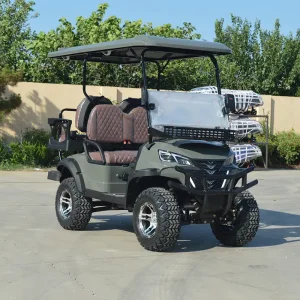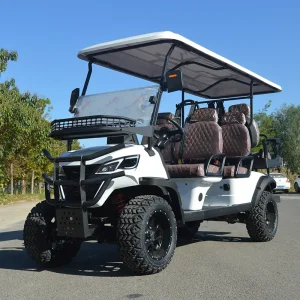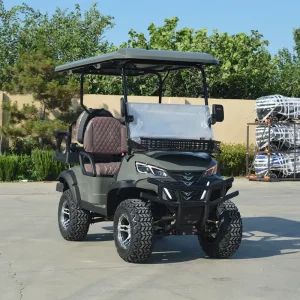
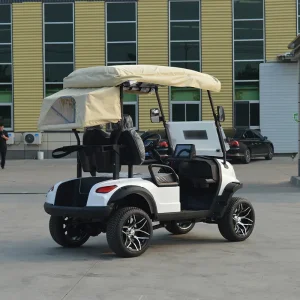
Featured Electric Mobility & Golf Cart Platforms
Explore our production-ready utility, resort, and commercial low-speed electric vehicles engineered over our modular structural frames.
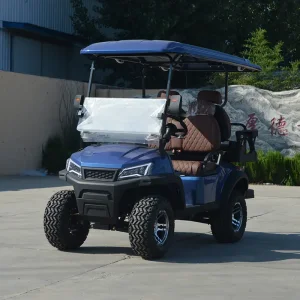
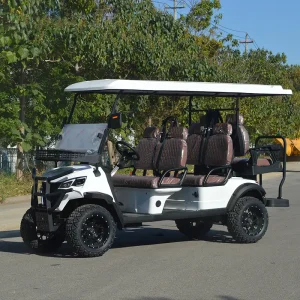
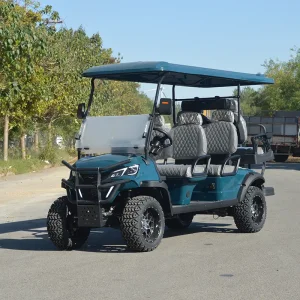
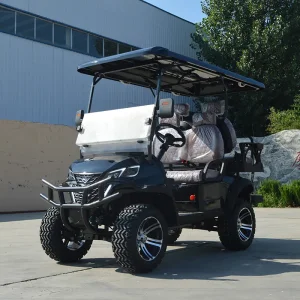
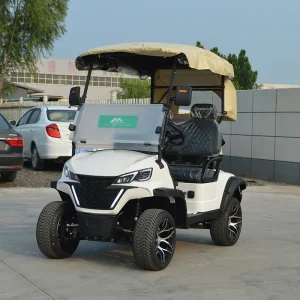
Structural Architecture of Modern Electric Golf Cart Frames
In-depth analysis of metallurgical specifications, finite element stress analysis (FEA), and robotic welding protocols that govern tier-one electric golf cart and low-speed vehicle (LSV) chassis design.
High-Yield Q235B vs. 6061-T6 Aluminum Alloys
The structural backbone of any electric golf cart chassis relies directly on material tensile yield threshold. Industrial tubular Q235B cold-drawn low-carbon steel provides superior flexural elasticity under multi-axis dynamic road shock, offering a yield strength ≥ 235 MPa and exceptional weld pool penetration.
Conversely, for marine-zone resorts and ultra-light high-efficiency passenger carriers, aircraft-grade 6061-T6 aluminum extrusion sub-frames reduce unsprung chassis weight by up to 42%, vastly optimizing battery watt-hour consumption per kilometer while eliminating galvanic rust risks.
Finite Element Analysis (FEA) Torsional Rigidity
Utilizing computerized multi-axis stress simulations, our golf buggy frames are modeled against worst-case torsional oscillation. Full passenger loads across four, six, or eight seats subject a stretched wheelbase to immense longitudinal sagging forces and angular twisting moments during uneven terrain transit.
Reinforced central spine designs, boxed suspension pickup gussets, and ladder-frame perimeter rails elevate static torsional stiffness beyond 18,500 Nm/deg, preventing body-panel creaks, steering rack misalignment, and premature weld fatigue over decades of continuous operation.
Automotive-Grade Cathodic E-Coating (EPD)
Surface degradation is the leading point of failure for sub-standard golf buggies operating in humid coastal resorts and fertilizer-rich golf greens. Our fabrication line incorporates a 14-stage immersion pre-treatment bath featuring hot alkaline degreasing, zinc phosphate micro-crystallization, and full cathodic electro-deposition.
An even 25μm epoxy coating coats every blind cavity, inner hollow tube, and gusset fillet. This is cured at 180°C, easily surpassing ASTM B117 neutral salt spray testing exceeding 1,200 continuous hours without blister proliferation.
Critical Engineering Directive for Fleet Procurement Officers:
A golf cart frame is not merely an assembly skeleton; it constitutes the primary grounding plane and kinetic energy crash dissipation envelope. When sourcing chassis from Chinese manufacturers, verify that the jig fixtures use digital pneumatic clamps and that stress relief heat treatment is documented for all steering neck knuckles and suspension arms.
Why Global LSV Brands Sourced from Dezhou Industrial Clusters
The geographic integration of China's Shandong EV industrial base offers unmatched vertical economies of scale, component standardization, and high-velocity tooling iteration.
100% In-House Tooling & Laser Hydroforming
Our 13,000 m² Dezhou manufacturing facility houses automated 12,000W 3D fiber laser tube cutters capable of complex beveling, slotting, and interlocking tab geometry. Interlocking joint configurations ensure self-aligning tubular fits prior to welding, eliminating human jig error.
Robotic MIG Multi-Axis Welding Cells
Equipped with 6-axis ABB and FANUC robotic welding stations operating with 80/20 Argon-CO2 shielding gas. Seamless bead consistency, zero spatter formation, and standardized penetration depths guarantee identical mechanical resilience across every single production run.
Hyper-Integrated Powertrain Ecosystem
Located in the epicenter of low-speed EV component manufacturing. Direct upstream access to high-efficiency AC motors, Curtis/Enpower digital vector controllers, and integrated high-ratio transaxles cuts supply lead times and eliminates secondary trading markups.
Agile OEM/ODM Modular Customization
Whether lengthening a 2-seater runabout into an extended 8-passenger hospitality shuttle, incorporating hydraulic 4-wheel disc brake mounts, or fabricating custom rear drop-down utility cargo beds, engineering modifications are executed within 7 to 10 working days.
Future Trends: Next-Gen Chassis Architectures (2025–2030)
How the transition to high-voltage lithium battery packs, solar integration, and IoT telematics is fundamentally redesigning low-speed vehicle underpinnings.
Structural LiFePO4 Battery Integration
Traditional golf cart frames relied on heavy, deep-drop sub-baskets designed to hold corrosive lead-acid battery blocks weighing upwards of 300 kg. The global shift toward 72V and 48V Lithium Iron Phosphate (LiFePO4) chemistries has revolutionized sub-chassis engineering.
Modern frames incorporate hermetically sealed structural battery trays that act as stressed chassis members. This lowers the vehicle's center of gravity (CG) by 85mm, eliminates roll-over risks on steep fairway banks, and increases dynamic yaw stability at speeds up to 40 km/h.
High-Strength Solar-Ready Roof Struts
With self-sustaining energy becoming paramount across resort fleets, top frame architectures must support integrated monocrystalline photovoltaic solar roofs. Vibrational harmonics from roof-mounted solar arrays require heavy-duty aerodynamic extruded uprights with concealed internal wiring conduit channels.
Reinforced overhead Roll-Over Protective Structure (ROPS) nodes ensure compliance with OSHA and ISO 3471 roll-protection guidelines without compromising sightlines.
Smart Telematics & Drive-By-Wire Adaptation
The emergence of geofenced autonomous golf buggies and remote fleet monitoring requires chassis pre-drilled for dual-redundant electronic power steering (EPS), CAN-bus wiring channels, and LiDAR/ultrasonic sensor mounting tabs.
Factory-integrated sensor hardpoints protect sensitive fleet telematics hardware from stone chips, water immersion, and severe chassis vibrations.
B2B Sourcing Protocol: Quality Verification & CKD Shipping
A complete risk-mitigation checklist for institutional buyers, municipal fleet procurement officers, and international importers ordering containerized chassis units.
CMM Dimensional Inspection & Alignment
Critical suspension mounting points must hold strict positional tolerances to prevent premature tire scrubbing and erratic high-speed steering drift. We deploy Coordinate Measuring Machines (CMM) and laser scanning arms to confirm axle-to-axle squareness within ±0.5mm across the entire 2,400mm–3,800mm wheelbase span.
SKD / CKD Optimized Container Stacking
Ocean freight costs represent a critical component of landed unit cost. Our golf cart frames feature modular, stackable sub-assemblies. Bolt-on rear subframes, removable front bumper crash boxes, and nestable roof hoops allow up to 28 completely knocked down (CKD) 4-seater chassis units to pack neatly into a single 40ft High Cube container.
Homologation Readiness: DOT, EEC & CE
To qualify for Low-Speed Vehicle (LSV) road registration under US FMVSS 500 or European L6e/L7e type-approval, our frames provide pre-engineered brackets for 3-point seatbelts, side rearview mirrors, illuminated license plate pods, and mechanical handbrake cable conduits.
Chassis Configurations Across Demanding Real-World Use Cases
Engineered for extreme duty cycles: tailoring suspension geometry, load ratings, and metal coatings to distinct commercial operating environments.
Coastal Resorts & Tropical Island Fleets
High humidity and saline sea breezes devastate unshielded steel. For luxury beachfront resorts, we deliver hot-dip galvanized or 6061-T6 aluminum frames with Dacromet-coated fasteners, ensuring 10+ years of rust-free aesthetics and integrity.
Gated Communities & Urban LSVs
Passenger comfort and low noise vibration harshness (NVH) dominate urban residential demand. Frames feature independent Macpherson or double A-arm front suspension sub-structures, paired with automotive rack-and-pinion steering pickups for a smooth ride.
Industrial Campuses & Heavy Cargo Transport
Airports, logistics hubs, and manufacturing campuses demand immense payload capabilities. Reinforced chassis crossmembers paired with heavy-duty multi-leaf rear springs support cargo beds carrying over 1,000 kg without frame sag or brake imbalance.
High-Gradient Mountain Golf & Off-Road Buggies
Navigating 25°+ alpine fairway inclines and rugged woodland paths requires elevated ground clearance (210mm+) and gusset-reinforced rear motor hangers to withstand intense motor launch torque without frame deflection.
Engineering Specification Matrix: Chassis Series Breakdown
Compare core metallurgical grades, structural weight, corrosion barrier techniques, and recommended operating cycles across our standardized manufacturing lines.
| Chassis Class | Base Material & Wall | Tensile Yield | Anti-Corrosion Finish | Payload Rating | Compliance Ready |
|---|---|---|---|---|---|
| Standard Resort 2/4-Seat | Q235B Tubular Steel (2.5mm) | ≥ 235 MPa | Cathodic E-Coat + Top Powder Coat | 450 kg | CE Certified |
| Extended 6/8-Seat Commercial | Reinforced High-Tensile Steel (3.0mm) | ≥ 310 MPa | 14-Stage EPD Primer + Polyurethane | 900 kg | ISO 9001 / CE |
| Aerospace Aluminum Ultra-Light | 6061-T6 Extruded Alloy (3.2mm) | ≥ 276 MPa | Anodized + Marine-Grade Epoxy Barrier | 550 kg | FMVSS 500 Ready |
| Heavy Industrial Utility & Cargo | Double-Boxed Channel Q345B (3.5mm) | ≥ 345 MPa | Hot-Dip Galvanized (>85μm Zinc) | 1,200 kg | EEC / L7e Compliant |
| Off-Road Adventure Buggy (G90) | Seamless Chromium-Moly Tube Matrix | ≥ 400 MPa | Dual-Dip Zinc Phosphate + E-Coat | 750 kg | CE / Off-Road ROPS |
Frequently Asked Engineering & Procurement Questions
Direct answers to the most common metallurgical, logistics, and homologation inquiries posed by international distributors and volume buyers.
What distinguishes an authentic automotive-grade E-coat from standard dip-painting? ▼
Can frame battery mounting brackets accommodate both lead-acid and custom LiFePO4 packs? ▼
How do you maintain chassis dimensional precision across stretched 6-seat and 8-seat models? ▼
What documentation is supplied to support local LSV homologation and road registration? ▼
What is the minimum order quantity (MOQ) for custom-engineered chassis designs? ▼
How do you protect bare chassis frames from corrosion during sea freight transit? ▼
Explore Complete Commercial & Specialized Vehicles
Select from our globally certified electric buggies, multi-passenger touring cars, and customized utility vehicles manufactured to rigorous industrial standards.