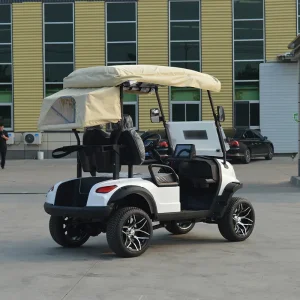
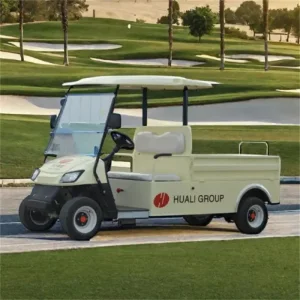
Signature Commercial Electric Buggy Fleet
Engineered for high duty-cycles, optimal energy conversion, and customizable chassis configurations. Explore our top 8 enterprise low-speed vehicles ready for worldwide export.


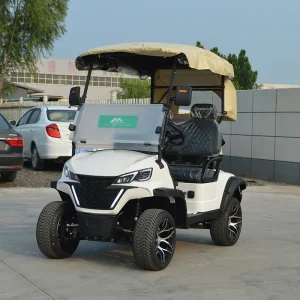
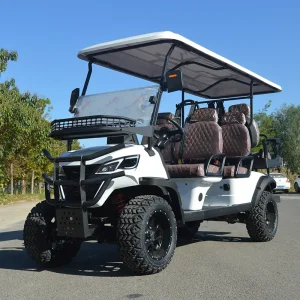
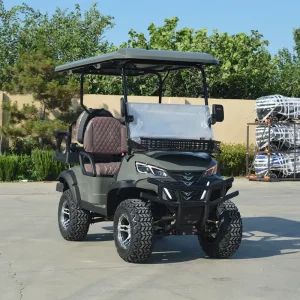
The Paradigm Shift to "Cool" Smart Low-Speed Electric Vehicles (LSEVs)
Beyond traditional fairway buggies: Why commercial hospitality resorts, gated master-planned communities, and municipal operations are shifting to custom, high-torque aesthetic electric platforms.
The global low-speed electric vehicle (LSEV) landscape has moved decisively past the era of generic, sluggish utility carts. Historically dominated by rudimentary 36V or 48V lead-acid golf buggies constrained to manicured golf links, current commercial procurement requires an entirely transformed architecture. "Cool electric golf carts" today embody high-power density, aggressive aesthetic styling, elevated ground clearance, multi-terrain independent suspensions, automotive-grade CAN-bus telemetry, and customized coachwork engineered to elevate brand perception for world-class resorts, smart campuses, and high-density residential developments.
At Dezhou Leibin Vehicle Industry Co., Ltd. (operating our integrated 13,000 m² smart factory in Wucheng County, Dezhou, Shandong), our engineering doctrine treats every low-speed vehicle not as an electrified toy, but as a severe-duty commercial asset. By combining high-tensile robotic chassis welding, automated cathodic electrodeposition (e-coating), and high-efficiency permanent magnet synchronous motors (PMSM) paired with intelligent lithium iron phosphate (LiFePO4) battery management systems, our ODM and OEM vehicle programs provide global fleet operators with unparalleled durability, reduced total cost of ownership (TCO), and distinct visual styling that captures market attention.
72V Powertrain Dynamics
Higher operating voltage reduces thermal resistance losses, yielding 38% more hill-climbing torque, rapid 0–40 km/h acceleration, and enhanced thermal longevity during continuous full-payload operation.
Structural Chassis Rigidity
Robotically jigged tubular steel chassis protected by automotive electrophoretic dipping, resisting salt spray corrosion and torsional fatigue across uneven resort pathways and rugged trails.
Solar Integration (G90 Series)
Integrated mono-crystalline photovoltaic roof canopies continuously top-up lithium reserve cells during daytime idle periods, extending battery service life and offering zero-carbon operational range.
Full ODM / White-Label Flexibility
From exterior thermoplastic body moulds, custom dual-tone marine vinyl stitching, LED matrix projector light signatures, to fleet IoT telematics branding tailored for volume importers.
Architectural Teardown: 72V Lithium vs. Traditional 48V Systems
A rigorous engineering comparison outlining how voltage architecture, motor topology, and electrochemical storage influence lifecycle reliability and slope performance.
| Performance & Engineering Dimension | Legacy Lead-Acid 48V Carts | Standard 48V Lithium Retrofits | Leibin 72V Lithium Advanced ODM Platform |
|---|---|---|---|
| Nominal System Operating Voltage | 48V DC (typically 6x 8V lead-acid series) | 48V - 51.2V DC Lithium Pack | 72V - 76.8V High-Potential DC Architecture |
| Motor & Controller Topology | Shunt-wound DC or rudimentary AC (2.5kW - 3.5kW) | Standard AC Induction (3.5kW - 4.0kW) | Permanent Magnet Synchronous AC (5.0kW - 7.5kW Peak) |
| Peak Electrical Current & Wiring Thermal Load | High I²R thermal strain; voltage sags over 120A draw | Moderate current demand; elevated under heavy inclines | Low Current Draw (35% less heat loss); cool high-torque efficiency |
| Gradeability / Hill Climbing Capability | 12% - 15% (steep speed decay under 4+ passenger loads) | 15% - 20% max gradient | 25% - 35% continuous gradeability under full 6-passenger load |
| Battery Cycle Life & Degradation | 400 – 600 cycles (30% capacity loss; acid stratification) | 1,500 – 2,000 cycles | 3,500+ deep cycles (LiFePO4) with smart multi-cell active BMS |
| Chassis Corrosion & Finish Quality | Basic primer powder-spray; prone to weld seam rust | Standard electrostatic paint | Automotive Electrophoretic Dip (Cathodic E-Coat) + Marine Seals |
| Braking System Security | Rear mechanical drum brakes (extended stopping distance) | Rear hydraulic drum or disc | 4-Wheel Hydraulic Disc Brakes + Regenerative Electromagnetic Stop |
| Fleet ROI & 5-Year Maintenance Cost | High labor (water topping, terminal clean, battery replace) | Moderate; battery swaps required at mid-life | Lowest TCO: Zero watering, 65% brake pad saving via regen braking |
Information Gain Insight: The core mathematical reality of Ohm’s and Joule’s laws ($P = V \times I$ and $P_{loss} = I^2 \times R$) demonstrates why 72V architecture is technologically superior for cool, multi-passenger golf carts. Generating 5,000 watts of tractive force on a 48V line demands over 104 Amperes through the harness and motor commutators, generating extreme heat and triggering voltage sag. By elevating operating potential to 72V, the required current drops to ~69 Amperes, cutting thermal resistance losses by over 56%. This ensures that when climbing 25-degree inclines in luxury mountain retreats or running round-the-clock sightseeing shuttles, the Leibin drivetrain runs cool, maintains punchy acceleration, and maximizes range per kilowatt-hour.
Worldwide Homologation, Street-Legal Compliance & Import Safeguards
Eliminate customs friction and regulatory road-blocks. Leibin engineers vehicles precisely configured to satisfy destination country statutes and automotive safety standards.
North America: FMVSS 500 & SAE J2358
For US street-legal low-speed vehicles (LSV/NEV), units feature DOT-stamped AS4 laminated glass windshields, automotive-grade windshield wipers, three-point inertia-reel seatbelts, illuminated side reflectors, DOT-approved rearview mirrors with turn signals, and electronic speed governors calibrated strictly between 20 mph and 25 mph (32–40 km/h) with 17-digit VIN stamping.
European Union: CE, EEC L6e & L7e
Equipped with E-mark certified LED projector headlights, low-speed acoustic vehicle alert systems (AVAS) for pedestrian safety, dual-circuit hydraulic disc brakes with mechanical emergency parking locks, E-mark safety glass, and complete documentation packages including EC Certificates of Conformity (CoC) to facilitate member-state road registration.
Dangerous Goods Logistics: UN38.3 & MSDS
Lithium energy storage safety is non-negotiable. Leibin lithium packs carry full UN38.3 test certificates (altitude, thermal, vibration, shock, external short circuit, and forced discharge), certified MSDS dossiers, and IMDG-compliant ocean shipping steel-crate bracing preventing cargo damage during international transit.
Versatile High-Yield Commercial Scenarios
Engineered to excel beyond traditional fairways: discover how Leibin electric buggies drive revenue, guest satisfaction, and operational efficiency across premier commercial venues.
Luxury Resorts & Private Island Hospitality
Ultra-quiet 72V AC motors ensure undisturbed guest serenity. Fitted with custom diamond-stitched leather upholstery, multi-speaker Bluetooth sound bars, integrated coolers, and luggage racks for seamless VIP transfers and beachside villa shuttles.
Master-Planned Communities & Eco-Estates
Serving as the primary second-vehicle for zero-carbon neighborhoods. Street-legal configurations provide convenient grocery runs, school shuttling, and neighborhood social outings with automotive dash screens and backup cameras.
Industrial Campuses & Heavy Logistics (G30)
Configured with heavy-duty aluminum dropside cargo beds, heavy-gauge steel bumper guards, and heavy-duty front hitch receivers. Capable of transporting tools, maintenance teams, and 500+ kg payloads silently across massive manufacturing sites.
Eco-Tourism, Nature Reserves & Safari Parks
Zero local tailpipe emissions safeguard wildlife habitats and pristine wilderness areas. High-capacity 72V lithium packs deliver 90+ km per charge, while our G90 solar roof tops up batteries autonomously off the grid.
Next-Generation Smart Micro-Mobility Roadmap
How Dezhou Leibin is pioneering connected telematics, intelligent autonomous geo-fencing, and smart energy grids for commercial fleet managers worldwide.
IoT Cloud Telematics & Remote Geofencing
Our upcoming generation integrates 4G LTE/GPS telematics allowing fleet operators to remotely monitor real-time battery SoC, enforce geo-fenced speed limit zones (e.g., automated slow-down near pedestrian paths or clubhouse entrances), track maintenance intervals, and execute Over-The-Air (OTA) motor controller tuning without physical technician visits.
Bi-Directional V2X & Smart Micro-Grid Integration
Expanding our LiFePO4 battery architectures to incorporate Vehicle-to-Home (V2H) and Vehicle-to-Grid (V2G) capabilities. Large golf resort fleets sitting plugged into charging stations during peak evening tariff hours can discharge surplus reserve capacity back to offset facility utility surcharges, transforming inactive fleets into distributed micro-powerplants.
Solid-State Cell Evolution & Recyclability
Collaborating with tier-1 battery cell research consortia to assess semi-solid-state chemistry for extreme climate resilience. This technological milestone will unlock operating thresholds from -30°C to +60°C without battery pre-heating degradation, while improving volumetric energy density by 30% for sleeker under-seat packaging.
Frequently Asked Questions: Global B2B Sourcing
In-depth, candid guidance on manufacturing lead-times, warranty parameters, ODM customization, logistics crating, and total cost of ownership calculations.
Enterprise Fleet & Special Utility Series
From agile 2-passenger facility transporters to 6-seater high-capacity shuttles and solar-powered off-road vehicles. Direct wholesale pricing from our Shandong factory.