
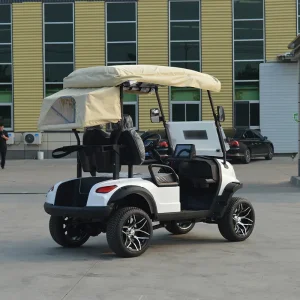
China Affordable Electric 2 Seater Mini Sightseeing Car Golf Cart from China Suppliers and Factory Supplier, Factories
Inquire Spec Sheet
Engineered for hospitality, resort connectivity, closed-campus logistics, and municipal utility operations with optimized 48V/72V powertrain platforms.





Moving beyond utilitarian course buggies to purpose-engineered Low-Speed Electric Vehicles (LSEVs). Why mechanical integrity and electronics integration dictate fleet longevity.
Dedicated Production Facility
LiFePO4 Deep-Cycle Lifespan
Chassis Defect Tolerance
High-Torque Powertrain Bus
Commercial-grade 2-seater platforms demand micro-alloyed tubular steel framing. Utilizing robotic jig welding and multi-stage cathodic electrodeposition (ED coating), Leibin chassis achieve over 1,000 hours of neutral salt spray resistance (ASTM B117), vital for coastal golf resorts and tropical island developments where atmospheric humidity accelerates oxidative corrosion.
Modern fleets are transitioning exclusively to 72V Lithium Iron Phosphate (LiFePO4) systems with integrated CAN-bus Battery Management Systems (BMS). Compared to traditional lead-acid cells, LiFePO4 eliminates terminal acid sulfation, requires zero watering maintenance, reduces vehicle kerb weight by up to 140 kg, and charges from 20% to 80% State-of-Charge (SOC) within 2.5 hours.
Leibin incorporates high-efficiency Permanent Magnet Synchronous Motors (PMSM) paired with intelligent Vector Field-Oriented Controllers (Curtis / Enpower platforms). This configuration achieves greater than 92% electromechanical efficiency, offering regenerative downhill braking, hill-hold safety assist, and exceptional gradeability exceeding 25% incline without thermal throttling.
Examining the vertical integration, Bill of Materials (BOM) cost efficiency, and specialized EV industrial clusters in Shandong Province.
Direct factory production bypasses export trading intermediaries. By executing chassis bending, structural welding, powder coating, wire harness manufacturing, and final assembly under a single 13,000 m² facility, margins are protected, delivering a 25–35% direct cost advantage for procurement departments.
Chinese light-electric-vehicle clusters share deep Tier-2 supply chains for rack-and-pinion steering gears, hydraulic disc braking calipers, and automotive-grade injection-molded ABS/PP bodies, making spare parts globally accessible and cost-effective throughout a 10-year lifecycle.
Unlike Western suppliers bound to static catalog offerings, Chinese suppliers offer agile custom development: utility cargo-bed extensions, customized luxury marine upholstery, solar photovoltaic canopies, and telematics integration with low tooling development thresholds.
Container logistics are systematically optimized. Using custom-engineered structural steel packing cradles, Leibin packs up to 24 units in Semi-Knocked-Down (SKD) form per 40-foot HQ container, slashing ocean freight expenditure per unit by up to 55% compared to fully built shipments.
A systematic audit matrix outlining standard commercial parameters across low-voltage utility and high-voltage performance tiers.
| Evaluation Parameter | Commercial 48V Lead-Acid Standard | Industrial 72V LiFePO4 Platform | Leibin G-Series High Performance |
|---|---|---|---|
| Nominal Battery Chemistry | Flooded / AGM Lead-Acid (8V × 6) | Lithium Iron Phosphate (LiFePO4) | LiFePO4 with Intelligent CAN-BMS |
| Motor Architecture | 3.0 kW DC Series / Shunt Wound | 4.0 kW AC Induction | 5.0 kW AC or PMSM High-Torque |
| Controller Frequency / Rating | 275A Curtis Analog | 350A Solid-State Digital Vector | 400A Curtis / Enpower AC Vector |
| Full Discharge Cycle Life | 450 – 600 cycles (50% DOD) | 2,000 – 2,500 cycles (80% DOD) | 3,500+ cycles (100% DOD to 80% SOH) |
| Continuous Cruising Range | 45 – 60 km per charge | 80 – 100 km per charge | 120 – 150 km (Dual-pack / Solar option) |
| Hill-Climbing Gradeability | 15% Max Gradient | 20% Max Gradient | 25% – 30% Incline Capability |
| Chassis Corrosion Treatment | Single-stage Liquid Paint | Electrostatic Powder Coat | Automotive Cathodic Electrodeposition |
| Street-Legal Homologation Ready | Non-Compliant (Closed Turf Only) | Optional Light Kits | DOT FMVSS 500 & EEC L6e/L7e Ready |
When selecting 2-seater electric golf carts for high-relief topography (e.g., cliff-side golf layouts, Alpine resorts, or Mediterranean hillsides), continuous motor rating takes precedence over peak kilowatt figures. DC setups generate heavy thermal losses via brushed commutators. A 72V AC or PMSM setup maintains lower winding temperatures, preventing controller derating during extended 20%+ ascents.
Procuring low-speed vehicles demands absolute compliance with cross-border municipal road transport directives.
For an electric 2-seater to qualify as a street-legal Low-Speed Vehicle (LSV) on public secondary roads (speed limits ≤ 35 mph / 56 km/h), federal regulations dictate strict mechanical minimums: DOT-certified AS1/AS4 laminated glass windshields with wiper assemblies, three-point SAE J386 seatbelts, dedicated turn signals, rear-view and side-view convex mirrors, parking brakes, red reflex reflectors, and valid 17-digit VIN stamping.
Within the EU, light micro-mobility is governed by Framework Regulation (EU) No 168/2013. The L6e-A (Light Quadrimobile) class limits vehicle speed to 45 km/h with an unladen mass under 425 kg. Requirements include E-Mark certified lighting lenses, dual-circuit hydraulic braking performance verification, certified horn acoustics, and electromagnetic compatibility (EMC/UNECE R10) testing to ensure zero RF interference.
Off-road closed-course utility models must strictly align with the CE Machinery Directive 2006/42/EC and Electromagnetic Compatibility Directive 2014/30/EU. Leibin provides transparent factory Declaration of Conformity (DoC), technical construction files (TCF), battery UN38.3 lithium safety certifications, and MSDS documentation needed for smooth customs clearance across European and American border ports.
How 2-seater electric golf carts drive bottom-line efficiency across specialized global commercial sectors.
Zero emissions, whisper-quiet electric drive systems preserve serene guest environments in luxury Maldives, Caribbean, and Mediterranean properties. Compact 2-seater footprints easily navigate tight landscaped walkways, private villa access paths, and pedestrian-first waterfronts without degrading delicate turf or paver infrastructure.
Gated residential communities in Florida, California, Spain, and the UAE utilize street-legal 2-seaters as primary neighborhood electric vehicles (NEVs). Delivering an economical, eco-friendly transit method for clubhouse transit, local shopping centers, and inter-community social commuting.
Mega-fulfillment centers, aviation hangars, and petrochemical plants deploy customized 2-seater configurations with rear payload flatbeds for facility maintenance supervisors, safety personnel, and emergency technical dispatch. Rapid acceleration and tight turn radiuses ensure high facility mobility.
Corporate headquarters, university campuses, and scenic parks rely on specialized 2-seater security packages equipped with overhead LED light bars, searchlights, PA systems, and lockable storage compartments, maintaining an approachable, highly visible security presence with low operational overhead.
The convergence of connected mobility, remote fleet diagnostic platforms, and renewable energy integration.
Next-generation 2-seater fleets incorporate factory-embedded 4G IoT telematics modules linked directly to vehicle CAN buses. Enterprise fleet managers access real-time GPS tracking, active geofencing boundaries, remote speed limiting for designated hazard zones, battery SOC monitoring, and automated fault reporting, reducing fleet maintenance downtime by up to 40%.
Integrating high-efficiency (22.8% cell efficiency) monocrystalline photovoltaic panels within the injection-molded roof structure allows continuous passive top-up charging during daytime operation. Under average insolation conditions, solar-augmented roofs inject an additional 15–20 km of driving range per day, dramatically reducing grid-charging reliance.
The progression toward electronic steering actuators and intelligent braking facilitates Level-2 autonomous capabilities within closed campus boundaries. Autonomous following modes, automated cart return algorithms for golf course clubhouses, and geofenced self-parking present transformational labor-saving opportunities for large operations.
Critical insights covering import compliance, engineering specifications, minimum order thresholds, and warranty coverage.
Discover complementary high-capacity platforms: 4-seater and 6-seater extended buggies built on the same robust chassis engineering.

