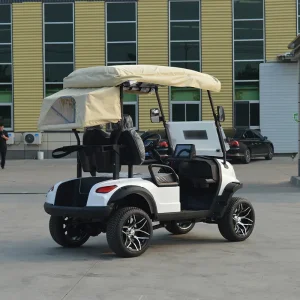
Commercial Golf Buggy & LSV Fleet Offerings
Verified production models equipped with automotive-grade chassis, brushless AC traction motors, and CE/DOT compliance platforms for international deployment.





The Global Commercial & Industrial Landscape of LSVs
How low-speed electric vehicles transitioned from fairway-exclusive runabouts to indispensable pillars of decarbonized municipal, resort, and industrial micro-mobility.
The Decarbonization Imperative
Global corporate ESG mandates and tightening municipal emissions covenants have accelerated the decommissioning of internal combustion utility fleets. Industrial campuses, luxury hospitality chains, and planned master communities are aggressively migrating to pure electric solutions that yield operational silence, zero tailpipe pollutants, and substantial carbon offset credits under international accounting protocols.
Micro-Mobility Diversification
The operational spectrum of the modern golf cart has radically broadened. Once restricted to the 18-hole golf course, these platforms now command the final-mile transport matrix of sprawling industrial warehousing, multi-terminal international aviation hubs, educational super-campuses, and gated suburban master-planned developments seeking road-compliant low-speed vehicles (LSVs).
Institutional Fleet Total Cost (TCO)
Commercial fleet operators calculate acquisition viability not merely on landed purchase cost, but on holistic five-to-ten-year lifecycle economics. The convergence of solid-state LiFePO4 battery packs, maintenance-free brushless AC induction drivetrains, and standardized automotive suspension has slashed operational overhead by upwards of 42% relative to antiquated lead-acid systems.
Golf Cart Evolution: The Technical Roadmap
Dissecting the leap from archaic DC series-wound, flooded lead-acid platforms to intelligent 72V AC permanent magnet motors, dual CAN-bus telemetry, and integrated photovoltaic roofs.
72V Architecture vs. 48V Legacy
Stepping the internal bus voltage from 48V to 72V reduces phase current by 33.3% for equivalent mechanical shaft output (P=VI). This substantial current reduction drops Joule-heating thermal losses ($I^2R$) across wire harnesses and switching MOSFETs by over 55%, preventing thermal de-rating during sustained gradient ascents.
Automotive LiFePO4 & Smart BMS
Lithium Iron Phosphate (LiFePO4) features an intrinsically stable olivine crystal structure that eliminates the risk of thermal runaway associated with ternary chemistries. Coupled with active balancing Battery Management Systems (BMS), these modules continuously track cell impedance, thermal thresholds, and state-of-health (SOH).
Monocrystalline Solar Augmentation
Integrated rigid-polycarbonate encapsulated monocrystalline solar roofs generate up to 280W-400W peak auxiliary input. Utilizing maximum power point tracking (MPPT) charge controllers, these canopies trickle-charge the main propulsion pack even when operating in remote outdoor areas, extending mission range by 15-22% daily.
CAN-Bus & Fleet Telematics
The inclusion of Controller Area Network (CAN-bus 2.0B) standardizes communication between the motor controller, BMS, onboard digital cluster, and optional 4G/GPS modules. Fleet managers execute real-time geofencing, remote electronic speed throttling, automated fault telemetry, and predictive maintenance scheduling.
| Architectural Parameter | Legacy DC / Lead-Acid Platforms | Evolution 48V Lithium Systems | Next-Gen 72V High-Torque Platforms (Leibin Standard) |
|---|---|---|---|
| Nominal System Voltage | 36V or 48V DC | 48.0V - 51.2V DC | 72.0V - 76.8V High-Potential Line |
| Traction Motor Technology | Series or Sep-Ex Brushed DC | AC Asynchronous Induction Motor | AC Permanent Magnet Synchronous Motor (PMSM) |
| Thermal Efficiency | 68% - 74% (Brush contact drag & heat) | 84% - 88% (Standard AC controller) | 92% - 96% (Vector Field Oriented Control - FOC) |
| Curb Weight Delta | Heavy (Pack adds 240kg - 320kg) | Standard (-120kg relative to lead-acid) | Optimized (-160kg relative to lead-acid, high power density) |
| Maximum Gradient Ability | 12% - 15% (Severe thermal drop) | 18% - 22% (Standard torque) | 25% - 32% Continuous (Full 6-passenger gross payload) |
| Maintenance Overhead | Weekly hydrometer, acid refill, cleaning | Zero electrolyte replenishment | Zero maintenance; Integrated active CAN balancing |
Chinese Supply Chain Resilience & Manufacturing Depth
Why sourcing directly from integrated manufacturing bases like Dezhou, Shandong yields unprecedented cost advantages, rapid customization cycles, and uncompromised build quality.
Hyper-Clustered Vertical Integration
The Dezhou and broader Shandong industrial corridor represents the world's most concentrated cluster for low-speed electric transport. Upstream metallurgical suppliers, automated robotic tube-bending facilities, cathodic electro-deposition (E-coat) paint systems, and Tier-1 wire harness fabricators operate within a 50-kilometer radius, drastically compressing lead times.
Scale Economies & Material Arbitrage
By leveraging vast domestic production runs that supply millions of specialty commercial vehicles annually, Chinese original equipment manufacturers achieve unrivaled raw-material purchasing leverage. This ensures that premium components—such as Curtis or Enpower controllers and high-density CATL/EVE cell modules—are integrated at competitive unit economics.
Agile OEM/ODM Prototyping
Western legacy manufacturers often mandate 18-month design iteration runways for custom chassis lengths or specialized municipal conversions. Chinese factory facilities operate with high tooling agility: CAD/CAM parametric alterations, 3D rapid tooling for body styling, and bespoke structural bracket stamping are realized within 30 to 45 business days.
Localized High-Impact Application Scenarios
Engineered to adapt to localized climate extremes, topological variance, passenger density, and municipal operating frameworks worldwide.
Planned Master Communities & HOAs
In Sunbelt states (US), Mediterranean private estates, and Gulf GCC gated developments, golf carts function as primary short-distance transit vehicles. Equipped with 3-point seatbelts, automotive-grade windshields, indicators, and DOT-certified tires, they interface seamlessly with local low-speed residential street networks.
Island Resorts & Mountain Escapes
Island resorts in Southeast Asia and the Caribbean require robust anti-saline chassis protection. Leibin uses hot-dip galvanization and marine-grade wiring. For high-gradient alpine resorts, 72V AC motors deliver 30% grade climbing without overheating, paired with regenerative descent braking for safety.
Heavy Industrial & Free-Trade Zones
Chemical processing complexes, multi-acre logistics yards, and port free-trade zones deploy 4-to-6 seat utility variants fitted with heavy cargo beds. Spark-free brushless AC induction motors and sealed solid-state controllers guarantee safe operation in areas where combustible fumes or dust hazards exist.
Civic Patrol & Healthcare Campuses
Universities, hospital networks, and municipal park authorities require high-visibility, continuous-duty utility runabouts. Rapid opportunity charging via onboard high-frequency smart chargers allows non-stop round-the-clock shift handovers with minimal downtime.
Homologation Protocols & Regulatory Safeguards
A rigorous verification matrix ensuring overseas importers, municipal fleet buyers, and regional distributors achieve friction-free customs clearance and local road registration.
US FMVSS No. 500 & SAE J2358
For vehicles designated for Low-Speed Vehicle (LSV) operation within the United States, configurations are built to satisfy 49 CFR 571.500 standards. This encompasses compliant headlights, front and rear turn signal lamps, tail lamps, stop lamps, reflex reflectors, exterior rearview mirrors (driver and passenger side), certified parking brakes, AS4/AS5 laminated windshields, and 17-digit VIN stamping.
European Union L6e / L7e Directives
Export configurations targeted for the European economic zone comply with Regulation (EU) No 168/2013 covering light four-wheelers. Key safety engineering audits include electromagnetic compatibility (EMC directive 2014/30/EU), dual-circuit hydraulic braking performance verification, certified seat anchorage tensile resistance, and low-voltage electric safety compliance.
UN38.3 & Sea/Air Transport Certification
Lithium power modules undergo extensive destructive testing protocols prior to shipping documentation release. This includes UN38.3 vibration, altitude simulation, thermal shock, external short circuit, impact, overcharge, and forced discharge verification. Dangerous Goods (DG) maritime declarations and MSDS dossiers accompany each bill of lading.
Need Market-Specific Homologation Documentation?
Our regulatory engineering desk assists distributors with localized type-approvals, Certificate of Conformity (COC) documentation, and custom VIN sequencing for government and municipal tenders.
Frequently Asked Procurement & Engineering Questions
Key technical, commercial, and operational queries answered by our senior automotive engineering team.
High-Efficiency Utility, Shuttle & Off-Road Configurations
Explore customized seating layouts, heavy payload utility beds, and specialized resort transportation solutions from our production facility.