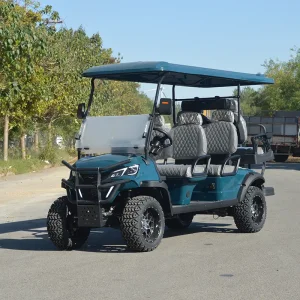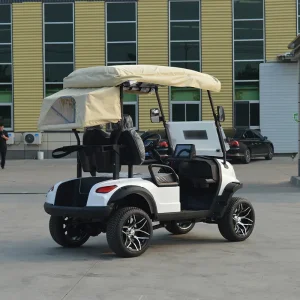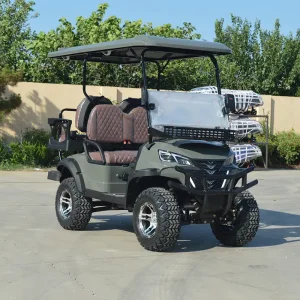
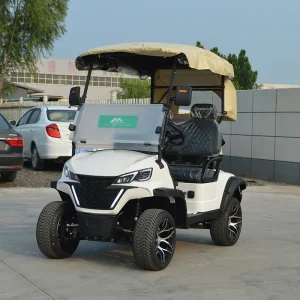
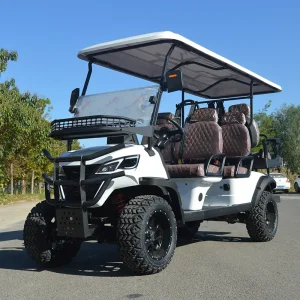
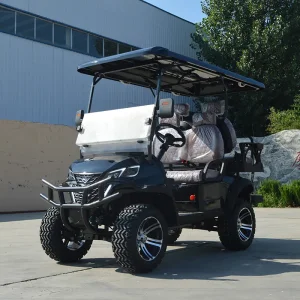
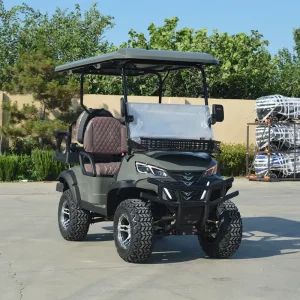
Featured Commercial Fleet Lineup: Series 01
Heavy-duty chassis, intelligent BMS power trains, and automotive-grade electrophoretic coatings precision engineered for demanding commercial resort, utility, and municipal deployments.
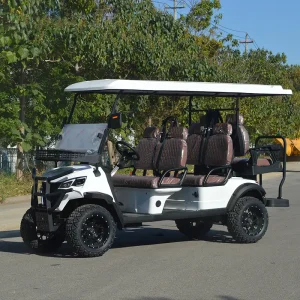
The Global Commercial & Industrial Landscape of Electric Golf Carts
The worldwide low-speed electric vehicle (LSEV) ecosystem is undergoing a generational shift. Moving far beyond traditional 18-hole fairways, electric carts and utility buggies now form the logistical backbone of international tourism, green community transit, industrial facilities, and municipal maintenance operations.
Micro-Mobility Urbanization
Urban planning trends in Master-Planned Communities (MPCs) and zero-emission lifestyle districts across North America, Australasia, and the GCC region mandate secondary vehicular systems. Low-speed electric buggies provide clean, noiseless, and pedestrian-compatible transit for short-distance neighborhood errands, school commutes, and local amenities.
Decarbonization of Hospitality
Global five-star resort brands, eco-lodges, and nature sanctuaries have instituted aggressive Scope 1 emission reduction mandates. Phasing out traditional carbureted two-stroke and four-stroke utility buggies in favor of silent 72V lithium sightseeing platforms preserves the acoustic and atmospheric purity that high-net-worth guests demand.
Intralogistics & Industrial Operations
Gigafactories, distribution centers, deep-water ports, and international aviation hubs require constant indoor-outdoor maintenance shuttling. Chinese original equipment manufacturers provide purpose-built heavy payload utility beds, hydraulic dumpers, and specialized tug variants that outperform conventional diesel light utility vehicles at a fraction of the lifecycle cost.
Key Evolutionary Trends Shaping Golf Cart Manufacturing
The convergence of automotive engineering standards, smart electronics, and battery chemistry is completely revolutionizing the design brief for Chinese low-speed electric buggy builders.
The 48V to 72V Lithium Paradigm
While legacy designs relied heavily on heavy 48V flooded lead-acid batteries, the modern market standard has aggressively pivoted to 72V Lithium Iron Phosphate (LiFePO4) systems. Higher operating voltage slashes internal resistance thermal losses, reduces required cable gauge thicknesses, elevates instantaneous climbing torque by over 35%, and supports rapid opportunity charging without memory degradation.
Automotive-Grade Homologation
Modern buyers no longer accept rudimentary steel tubing assemblies. Chinese manufacturing centers like Dezhou now utilize automotive-grade production methodologies: robotized fixture welding, robotic electrophoretic anti-corrosive priming (ED coat), hydraulic four-wheel disc braking with electronic park brakes (EPB), and FMVSS 500 / EU L7e compliant lighting and impact resistance structures.
Photovoltaic Auxiliary Harvesting
Integration of monocrystalline photovoltaic canopies directly into golf buggy roofs represents a breakthrough in operational autonomy. Generating between 150W and 350W of continuous trickle charge during daylight operation, high-efficiency solar roofs extend operational range by 15-25 km daily, substantially easing peak-load demands on resort charging infrastructure.
Localized Application Scenarios & Operational Duty Cycles
Different operational environments demand distinct torque curves, clearance heights, and battery endurance envelopes. Chinese factories engineer vehicle chassis to exact duty cycle profiles.
Resorts & Hospitality
Requirements: 4 to 6 seats, whisper-quiet AC motors, plush ergonomics, smooth hill start assist.
Chassis Duty: Constant stop-and-go guest shuttling across paved resort roads, steep gradient coastal paths, and beach accessways with high ambient humidity.
Golf Clubs & Fairways
Requirements: 2 to 4 seats, turf-friendly low-ground-pressure tires, caddie bag racks, scorecard holders.
Chassis Duty: Delicate turf preservation via wide footprint tires, hill holding capabilities up to 25% slopes, and rain cover enclosures.
Industrial & Security Patrol
Requirements: Beacon lighting, PA systems, lockable compartments, reinforced steel brush guards.
Chassis Duty: Continuous 24/7 rotational shifts across manufacturing complexes, petrochemical refineries, cargo terminals, and perimeter fences.
Gated Communities & LSV
Requirements: DOT-certified safety glass windshields, side mirrors with indicators, 3-point seatbelts, VIN registration.
Chassis Duty: Daily personal transit on designated public access roadways up to 40 km/h (25 mph) under local Low Speed Vehicle regulations.
Technical Roadmap & Architectural Comparison
Selecting the appropriate powertrain topology is critical to fleet operational efficiency. Below is an engineering comparison between conventional entry-level platforms and modern industrial 72V LiFePO4 setups.
| Engineering Parameter | Legacy 48V Lead-Acid System | Advanced 72V AC LiFePO4 Platform | Solar Hybrid 72V Flagship Platform |
|---|---|---|---|
| Nominal System Voltage | 48V DC | 72V DC (LiFePO4) | 72V DC + Solar MPPT Controller |
| Motor Architecture | DC Series / Separately Excited (3.0–4.0 kW) | High Efficiency AC Asynchronous / PMSM (5.0–7.5 kW) | Permanent Magnet Synchronous Motor (PMSM 7.5 kW) |
| Battery Cycle Life (to 80% DoD) | 500 - 700 Cycles (2 - 3 Years) | 3,500 - 5,000 Cycles (8 - 10 Years) | 3,500 - 5,000 Cycles (Active Float Balance) |
| Average Energy Density | 30 - 40 Wh/kg | 120 - 150 Wh/kg | 140 - 160 Wh/kg (Integrated System) |
| Curb Weight Impact | Heavy (~320 kg battery bank) | Ultra-Light (~75 - 95 kg battery pack) | Light (~90 - 110 kg battery + solar panel) |
| Maximum Gradeability (Full Load) | 15% - 18% | 25% - 30% | 28% - 35% |
| Effective Operating Range | 50 - 65 km per full charge | 100 - 140 km per full charge | 130 - 170+ km (Continuous Solar Extension) |
| Maintenance Routine | Bi-weekly distilled water topping, terminal corrosion clean | Maintenance-Free; Automated Cloud-Connected BMS | Maintenance-Free; Zero Liquid Electrolyte Top-Off |
| Braking & Recuperation | Mechanical Rear Drum + Mechanical Brake | 4-Wheel Hydraulic Disc + Electro-Magnetic Brake (EMB) | 4-Wheel Hydraulic Disc + EMB + Dynamic Regen |
Turnkey Solutions for Global Fleets & Importers
Leading Chinese manufacturers like Dezhou Leibin Vehicle Industry Co., Ltd. operate beyond simple unit sales, functioning as complete solutions architects for municipal operators, international rental franchises, and commercial developers.
Optimized Knock-Down Logistics (SKD/CKD)
To circumvent elevated intermodal ocean freight costs and steep import tariffs, Chinese factories engineer modular Semi-Knocked Down (SKD) and Completely Knocked Down (CKD) packing frameworks. Steel skeleton crates maximize container cube efficiency—allowing up to 18-24 units in a standard 40ft HQ container, slashing landed shipping costs per unit by over 60%.
Fleet Telematics & Remote IoT Diagnostics
Modern export golf carts feature factory-integrated CAN-bus IoT hardware modules. Commercial resort fleet directors gain live visibility into real-time battery pack state-of-health (SoH), individual cell temperatures, geofenced speed limiting, route history tracking, anti-theft immobilization, and automated preventive maintenance dispatching directly via web dashboard or API.
Compliance & Regional Homologation
Navigating destination-market safety regulations is standard operating procedure. Chinese manufacturing lines deliver specialized configurations matching United States DOT FMVSS Part 571.500 standards, European Union L6e/L7e type approvals, Australian ADR light vehicle regulations, and Middle East SASO/GSO climatic thermal certifications.
Frequently Asked Questions for Wholesale & Fleet Buyers
Clear, definitive technical and commercial answers addressing common engineering questions encountered by international distributors, import agents, and resort operations managers.
What specific advantages do 72V lithium systems deliver over legacy 48V golf carts in commercial operations?
What are the prerequisites for importing Chinese electric golf carts to achieve street legality in the US and Europe?
How do Chinese golf cart manufacturers prevent galvanic corrosion in harsh coastal resort environments?
What is the minimum order quantity (MOQ) and lead time for customized OEM/ODM fleet orders?
What after-sales parts support and remote diagnostic capabilities are provided to overseas distributors?
Featured Commercial Fleet Lineup: Series 02
Explore additional factory direct multi-passenger platforms, versatile utility vehicles, and heavy-duty resort shuttles built with robust components and precision engineering.