
Factory-Direct Electric Golf Carts & Utility Platforms
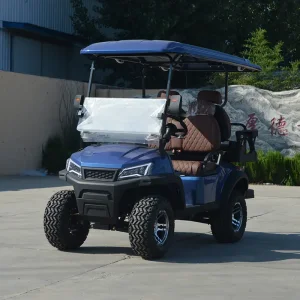
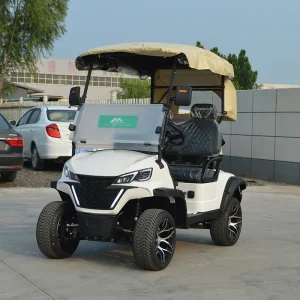
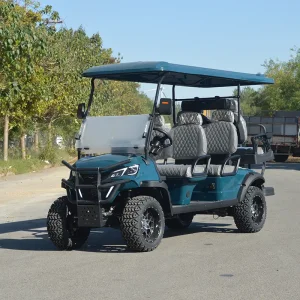
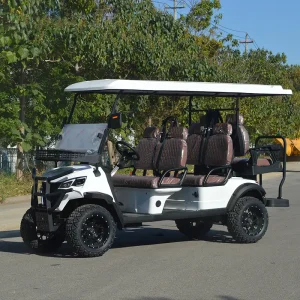
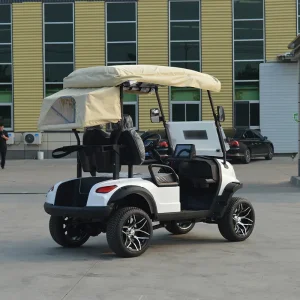
Explore frontline engineered units featuring robust 48V/72V lithium powertrains, solar charging architecture, and off-road chassis configurations directly supplied from our certified Chinese manufacturing base.
Why Global Buyers Partner with Chinese Golf Cart Manufacturers
The transition from legacy internal combustion buggies to intelligent electric low-speed vehicles (LSVs) has redefined competitive dynamics, making China the premier global epicenter for golf vehicle manufacturing.
Lithium Battery Vertical Integration
China commands over 75% of global LiFePO4 (Lithium Iron Phosphate) cell refining and battery pack production. Chinese golf cart factories leverage local Tier-1 cells with high volumetric energy density, integrated Battery Management Systems (BMS), and thermal dissipation protocols that surpass traditional lead-acid systems by delivering upwards of 3,500 full charge cycles at 80% Depth of Discharge (DoD).
Automotive Cathodic Electrodeposition (E-Coat)
Unlike workshops utilizing manual spray paint, premier factories like Dezhou Leibin Vehicle Industry deploy automated electro-coating immersion tanks and robotic MIG welding jigs. Every high-tensile tubular steel or aviation-grade aluminum alloy chassis receives complete phosphate treatment and cathodic electrophoresis, providing 1,000+ hours of ASTM B117 salt spray resistance essential for coastal resort environments.
Flexible OEM/ODM Scalability
Whether an international distributor requires custom molded ABS body fairings, specific RAL color codes, branded instrument clusters, high-speed gear ratios, or tailored 2+2, 4-seat forward, or 6-passenger configurations, Chinese OEM lines deliver rapid digital prototyping, mold engineering, and batch flexibility with minimum lead times unmatched in Western manufacturing corridors.
Dezhou Leibin Industrial Hub Insight: Situated in Shandong province's specialized vehicle manufacturing cluster, Leibin utilizes unified localized supply lines covering AC motors, high-frequency chargers, CAN-bus controllers, and hydraulic disc braking systems. This tight 50-kilometer supply radius minimizes tier-2 logistics overhead and eliminates lead-time variability for overseas fleet procurement.
Technology Megatrends Reshaping the Golf Cart Industry
The contemporary electric golf cart has evolved far beyond a low-power fairway runabout into a high-efficiency Low-Speed Vehicle (LSV) powered by smart drivetrains, edge IoT telematics, and renewable auxiliary charging systems.
Transition to High-Voltage 72V AC & PMSM Systems
While archaic 36V and 48V DC systems suffer from severe resistive thermal losses and rapid voltage drop under hill-climbing conditions, modern Chinese plants emphasize 72V Alternating Current (AC) Induction and Permanent Magnet Synchronous Motors (PMSM).
Operating at 72V cuts system operating current by 33% to 50% for equivalent kilowatt power outputs. This dramatically reduces thermal stress on motor windings, enables continuous high-torque gradeability up to 30%, and extends the usable cruising radius per charge up to 120–150 kilometers under mixed load conditions.
Integrated CAN-Bus & IoT Telematics Fleets
Large-scale commercial operations such as gated hospitality chains and destination golf resorts demand precision asset management. Chinese manufacturers integrate Controller Area Network (CAN-bus) protocols coupled with 4G/GPS telematics gateways.
Fleet supervisors can perform real-time geofencing, remote digital speed locking, regenerative braking tuning, battery State-of-Health (SoH) and State-of-Charge (SoC) cell monitoring, and predictive failure diagnosis directly via centralized cloud software interfaces.
Monocrystalline Solar Canopy Integration
Models such as the Leibin G90 incorporate high-efficiency photovoltaic (PV) solar panels directly into the molded vehicle roof. Operating via an intelligent MPPT (Maximum Power Point Tracking) step-up charge controller, the solar roof trickles current directly into the 72V lithium pack during outdoor parking and fairway operation.
This continuous solar replenishment generates an auxiliary 15 to 25 km of supplementary cruising range each sunny day, reducing plug-in charging cycles, curbing peak utility charges, and preventing battery deep discharge damages.
Automotive Independent Double A-Arm Suspensions
Stepping away from archaic leaf springs, frontline Chinese factories now equip off-road and luxury golf carts with MacPherson front struts or independent double A-arm front suspensions coupled with hydraulic helical coil-over shocks.
Matched with four-wheel hydraulic disc brakes, electric parking brakes (EPB), and electromagnetic downhill regenerative braking systems, the ride dynamic matches passenger vehicle comfort and guarantees safe anti-roll stability on steep terrain.
Engineered Solutions for Distinct B2B Mobility Environments
A golf cart is no longer confined to the 18 holes of a golf course. Chinese factories engineer vehicle chassis configurations targeted at diverse enterprise application scenarios.
Luxury Resorts & Eco-Tourism Hospitality
Island resorts, safari lodges, and luxury 5-star destinations require whisper-quiet operation, zero localized tailpipe emissions, and premium passenger aesthetics. Leibin 6-seater and 8-seater luxury shuttle configurations feature plush marine-grade vinyl upholstery, onboard Bluetooth multimedia consoles, LED ambient step lighting, and smooth air-suspension damping to ensure first-class guest experiences.
Gated Residential Communities & Master-Planned Subdivisions
Across North America, Southern Europe, the Middle East, and Southeast Asia, Low-Speed Vehicles (LSVs) and Neighborhood Electric Vehicles (NEVs) have become the primary method of daily localized transit. Configured with DOT-certified laminated glass windshields, three-point seat belts, rearview mirrors with integrated turn signals, and digital speedometer consoles, our street-legal packages integrate effortlessly into neighborhood transit grids.
Municipal Security, Campus & Airport Patrol
Sprawling manufacturing facilities, university campuses, international air terminals, and waterfront boardwalks require responsive, high-duty patrol units. Leibin builds specialized patrol carts with overhead red/blue strobe lights, public address (PA) speakers, heavy-duty anti-collision steel bull bars, and lockable weatherproof compartments for security equipment and first-aid gear.
Industrial Warehousing & Cargo Utility Transit
Maintenance teams, landscape architects, and distribution logistics facilities require rugged utility beds. Models such as the Leibin G30 Utility feature reinforced hydraulic drop-tailgate aluminum cargo boxes capable of supporting 500+ kg payloads, allowing maintenance staff to transport heavy tools, turf seed, and facility equipment across rough work sites effortlessly.
Championship Golf Courses & Commercial Rental Fleets
High-turnover tournament courses and country clubs prioritize maximum up-time, turf preservation, and fast battery recharge between morning and twilight rounds. Low-weight aluminum chassis prevent soil compaction, while 2-hour high-amp rapid chargers allow golf courses to support double 18-hole rounds on a single fleet asset every day without maintenance interruptions.
Engineering Spec Sheet: 48V Lead-Acid vs. 72V Lithium Platforms
A rigorous quantitative technical analysis demonstrating why international fleet directors are phasing out lead-acid batteries in favor of Chinese 72V lithium-integrated vehicle architecture.
| Evaluation Parameter | Legacy 48V Deep-Cycle Lead-Acid | Leibin 72V LiFePO4 Lithium Platform | Operational Fleet Benefit |
|---|---|---|---|
| Battery Pack Weight | ~280 kg to 340 kg | ~75 kg to 95 kg | Saves 200+ kg curb weight; preserves golf course turf, increases acceleration. |
| Cycle Life Expectancy | 500 – 750 cycles (50% DoD) | 3,500 – 4,000 cycles (80% DoD) | Eliminates 3 costly battery replacement rounds across a 10-year vehicle lifespan. |
| Recharging Duration | 8 to 10 hours (constant current/voltage) | 2.5 to 3.5 hours (high-amperage CC/CV) | Enables opportunist fast charging between morning and afternoon shifts. |
| Continuous Gradeability | 15% to 18% max before thermal cutoff | 25% to 30% sustained slope ascent | Effortlessly climbs steep mountain resorts without stalling or motor overheating. |
| Routine Maintenance | Bi-weekly distilled water watering, terminal de-scaling | 100% Maintenance-Free Zero Maintenance | Slashes maintenance facility labor costs and prevents accidental acid spills. |
| Power Delivery Curve | Gradual voltage sag; slow speed as battery drains | Flat voltage discharge curve; full speed to 5% SoC | Consistent performance, vehicle speed does not drop during the final miles. |
| Operating Temperature | Severe capacity loss below 0°C (-40% capacity) | -20°C to +60°C (with internal thermal film) | Reliable year-round fleet performance in cold Nordic and scorching Gulf regions. |
Total Cost of Ownership (TCO) & Fleet Electrification Economics
A rigorous financial breakdown comparing 5-year fleet procurement of 50 units: Gas-powered buggies vs. Western assembled electric vs. Direct China factory supply.
Capital Expenditure (CAPEX) Reduction
Procuring turnkey fleets straight from an established Chinese manufacturer eliminates middleman importer margins, regional dealer franchise markups, and excessive freight premiums. Tier-1 China factory direct FOB pricing averages 40% to 55% lower than comparable US/European assembled buggies without sacrificing structural durability or electronic component quality.
Operational Expenditure (OPEX) Efficiency
Internal combustion (ICE) golf carts demand perpetual unleaded gasoline purchases, periodic engine oil renewals, spark plug replacements, fuel filter checks, and air belt servicing. Electric 72V lithium carts charge overnight at low off-peak electrical tariffs, slashing per-kilometer operating energy costs by up to 82% while eradicating garage engine noise and exhaust fumes.
Residual Value & Battery Warranty Protection
Lead-acid buggies lose 70% of their equity valuation after 36 months due to deteriorated battery packs requiring immediate $2,500 battery retrofits. In contrast, Chinese LiFePO4 packs carry 5-year factory warranties with projected operational life surpassing 8–10 years, securing exceptionally high secondary market trade-in values for resort operators.
International Regulatory Homologation & Shipping Optimization
A seamless blueprint for navigating North American FMVSS, European L6e/L7e type approval, and maximizing ocean container utilization ratios.
Street-Legal Compliance & Homologation
Procuring low-speed vehicles for highway or community public-road operation mandates strict adherence to local transportation authority regulations:
- United States (NHTSA / FMVSS No. 500): Vehicles configured as Low Speed Vehicles (LSV) feature top speeds between 20 mph and 25 mph, certified AS4/AS5 DOT safety glass windshields with electric wiper, 17-digit ISO VIN stamped chassis, DOT three-point inertia-reel seat belts, exterior side mirrors, horn, and full street-legal LED illuminations (low/high beam, brake lights, indicators, hazard lights).
- European Union (Regulation 168/2013 / L6e-A & L7e): Fully compliant lighting arrays with E-Mark certification, hydraulic dual-circuit braking, mechanical handbrakes, sound level certification, and Certificate of Conformity (CoC) documentation for local vehicle registration and license plate issuance.
- Hazardous Materials Transport (UN38.3 & MSDS): Factory lithium battery packs are certified under UN38.3 vibration, altitude, and thermal test standards, ensuring smooth customs processing and marine dangerous goods declarations (Class 9 DG).
Containerization Logistics: SKD vs. CKD Packing
Freight expenditures significantly impact landed landed unit costs. Dezhou Leibin provides tailored packaging logistics to minimize cubic meter (CBM) waste:
- Semi-Knocked Down (SKD) Iron-Crate Packaging: The vehicle roof and front wheels are detached while the chassis, powertrain, and wiring remain fully mounted. Individual heavy-duty steel skeleton racks allow 2-tier vertical stacking inside 40ft High Cube (HQ) containers. Typically, a 40ft HQ accommodates 16 to 20 units of 4-seater models, enabling rapid re-assembly within 30 minutes upon destination arrival.
- Completely Knocked Down (CKD) Packaging: Engineered for authorized overseas assembly distributors with dedicated tooling. Bodies, frames, axles, and drivetrains are packed in modular crates. This boosts container packing density up to 30–36 units per 40ft HQ, drastically cutting ocean freight cost-per-unit and qualifying the importer for reduced import duties in various jurisdictions.
High-Torque & Multi-Passenger Electric Golf Buggies
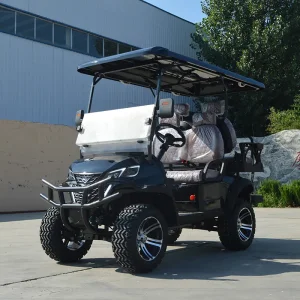
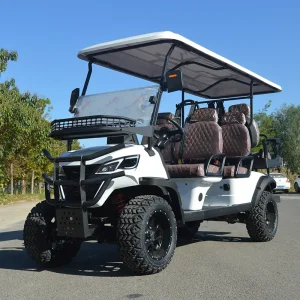
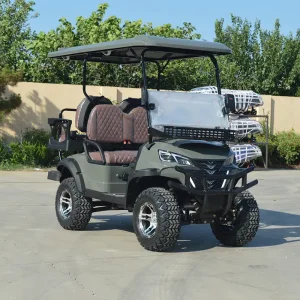
Explore our heavy-duty commercial sightseeing vehicles, 4+2 passenger transporters, and long-range 72V off-road utility carts engineered for global fleet reliability.
Frequently Asked Questions by Global Importers & Fleet Operators
In-depth engineering, operational, and commercial answers compiled by our chief technical export engineers.