

Tier-1 Fleet Portfolios
Engineered Heavy-Duty Fleet Vehicles: Core Product Line
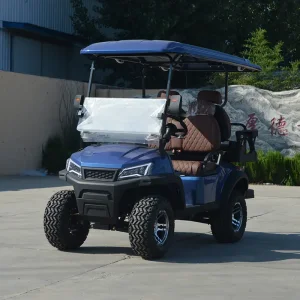
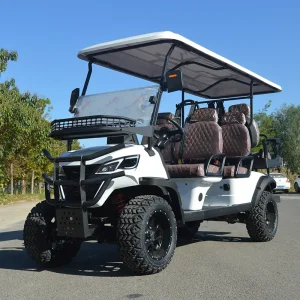
Precision-manufactured off-road, community, and commercial resort platforms engineered on solid-state controller architecture and structural aerospace-grade steel weldments.


Macro Market Intelligence
Global Commercial & Industrial Status of Electric Golf Cars
The worldwide Low-Speed Electric Vehicle (LSEV) landscape is transitioning from legacy resort fairways into diversified industrial, public transit, and residential utility sectors.
8.4%
Market CAGR (2024–2032)
72V LiFePO4
Dominant Architecture
13,000 m²
Manufacturing Footprint
3,500+
Charge Life Cycles
Commercial Fleet Modernization
Commercial facilities worldwide are phasing out noisy, carbon-intensive internal combustion engines in favor of high-duty-cycle 72V lithium platforms. Zero emissions, near-silent operation, and minimal operating maintenance optimize ROI across large deployments.
Industrial & Logistics Intralogistics
Modern gigafactories, distribution centers, and seaports deploy customized flatbed utility variants for inner-facility payload hauling. Engineered with regenerative braking and automated torque distribution, these platforms maximize battery run-time.
Master-Planned Communities
From Sun Belt master-planned golf residential zones in North America to eco-tourism enclaves across Southeast Asia, Street Legal Neighborhood Electric Vehicles (NEVs) demand compliant safety packages: FMVSS 500, DOT glass, and 3-point harness systems.
Technological Transformation
Engineering Trends: The Transition to High-Voltage Solid-State Mobility
Evaluating the shift from legacy 48V wet lead-acid platforms to intelligent, telemetry-enabled 72V Lithium Iron Phosphate (LiFePO4) systems.
| Performance Dimension | Legacy 48V Lead-Acid System | High-Torque 72V LiFePO4 Platform | ODM Engineering Impact |
|---|---|---|---|
| Energy Density & Weight | Heavy (~350 kg), corrosive acid hazards, rapid sulfation | Ultralight (~90 kg), dry cell, prismatic cell configuration | Reduces curb weight by ~60%, boosting hill-climbing and tire life |
| Operating Cycle Life | 400–600 deep cycles (18–24 months service life) | 3,500+ cycles to 80% DOD (8–10 years duty) | Reduces operational cost per operating hour by over 74% |
| Current Draw & Heat Loss | High amperage draw creates intense harness thermal stress | High voltage lowers operating current by ~33% | Eliminates controller thermal shutdown on continuous grades |
| Smart Telemetry & IoT | Analog voltmeters with inaccurate state-of-charge readout | Integrated CAN-Bus, Smart BMS with cell-level balancing | Enables real-time remote fleet health tracking and geofencing |
| Auxiliary Energy Harvesting | Incompatible with simple dynamic solar charging | Integrated MPPT solar charge roof integration | Extends daily range by 15-25 km via direct solar replenishment |
Operational Realities
Engineered Deployment: Localized Commercial Application Profiles
Tailored low-speed vehicle chassis specifications adapted to diverse operating terrains, thermal environments, and payload demands.
Rugged Terrain Resorts & Ecotourism
High-altitude luxury safari resorts and steep terrain demand double A-arm independent front suspensions, coil-over hydraulic shocks, 4-wheel hydraulic disc brakes, and high-torque AC brushless motors engineered for up to 30% hill climbing.
Airport Terminals & Corporate Campuses
Zero-emission indoor-outdoor passenger transfer buggies operating on non-marking tires. Smooth deceleration, whisper-quiet controllers, and sensitive electromagnetic auto-parking brakes provide consistent safety across crowded passenger zones.
Municipal Enforcement & Campus Patrol
Customized security and law-enforcement vehicles built with all-weather lockable cabins, roof-mounted strobe systems, public-address intercoms, integrated USB fleet dispatch mounts, and high-capacity battery units designed for uninterrupted 24-hour shift rotations.
Engineering Roadmap
Technical Roadmap: Next-Generation Electric Golf Car Architecture
Forward-looking industrial milestones transforming low-speed vehicles into autonomous, connected, and solid-state platforms.
Phase 1: Automotive CAN-Bus Integration
Eliminating sprawling analog wiring harnesses in favor of integrated dual CAN-bus systems that connect lighting, motor controllers, battery BMS, and digital clusters into a centralized diagnostic network.
Phase 2: L2+ Geofenced Autonomy
Integrating centimeter-accurate RTK-GPS guidance, ultrasonic distance radars, and drive-by-wire steering systems for automated club-to-maintenance returns, rental fleet repositioning, and pedestrian collision avoidance.
Phase 3: Centralized Cloud Fleet Portals
Dedicated SaaS control centers providing real-time geofence enforcement, speed throttling for sensitive zones, automated battery charge alerting, and predictive mechanical service alerts before field breakdowns happen.
Phase 4: Solid-State Battery Deployment
Prototyping commercial non-flammable solid-state electrolytes designed to handle broad temperature ranges (-30°C to +60°C) without degradation, doubling the vehicle operating range per square foot of battery tray.
Supply Chain Excellence
Turnkey Macro Solutions for Global ODM Distributors & Brands
Eliminating supply chain fragmentation through comprehensive in-house design, automated tooling, assembly line consistency, and international homologation support.
Bespoke Aesthetic & Mechanical Tooling
We design and manufacture thermoformed ABS and injection-molded automotive bodies, custom front grilles, proprietary LED light clusters, aluminum alloy wheels, and branded seat embroideries tailored to unique brand identities.
Regulatory Compliance & Homologation
Complete engineering file generation for international approvals: European CE/EEC low-speed light vehicle L6e/L7e type certifications, US FMVSS 500 LSV regulations, and ISO 9001 factory manufacturing controls.
Optimized CKD/SKD Export Packaging
Engineered steel-cage palletization systems designed to maximize sea-container capacity. Our Semi-Knocked-Down (SKD) and Completely-Knocked-Down (CKD) processes protect units during transit and simplify local re-assembly.
Direct Sourcing Catalog
Specialty Mobility & Sightseeing Vehicles: Fleet Solutions
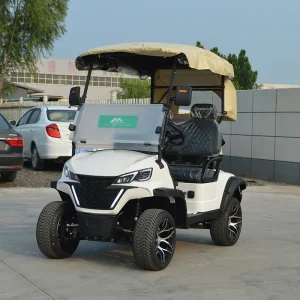
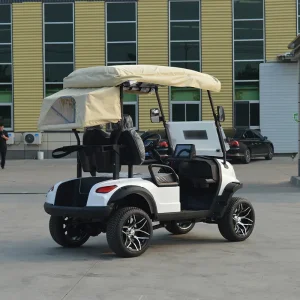
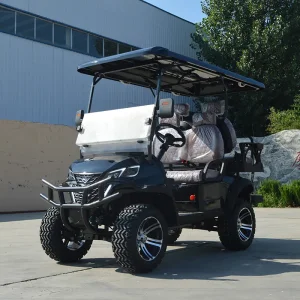
Explore our full line of passenger buses, street-legal club cars, and versatile multi-seat commercial golf buggies built for international distribution.
Procurement Knowledge Base
Frequently Asked Technical & Procurement Inquiries
Clear engineering answers addressing the operational, legal, and manufacturing questions critical to global low-speed vehicle buyers.
What specific engineering standards ensure your carts are street-legal?
Street legality depends on destination country standards. For North America, we configure our vehicles to meet Federal Motor Vehicle Safety Standard (FMVSS) No. 500 for Low-Speed Vehicles (LSV), including DOT-certified windshields with wipers, 3-point seatbelts, dedicated turn indicators, reflex reflectors, side-view mirrors, and precise 25 mph (40 km/h) speed limiters. For European markets, vehicles can be supplied with compliance packages aligned with L6e/L7e type-approval regulations.
Why is a 72V AC motor system superior to a conventional 48V DC configuration?
A 72V alternating current (AC) architecture operates at a higher potential voltage, reducing current draw for the same mechanical power output. This lower current reduces resistive heat generation across cables and motor controllers by over 30%, which extends range and prevents thermal cutoff during steep climbs. AC motors also feature regenerative braking and eliminate wearable carbon brushes, reducing lifetime drive-motor maintenance.
What level of brand and component customization is supported for ODM orders?
We offer comprehensive ODM customization. This includes custom exterior injection molds, bespoke front grilles, pantone-matched body colors, premium marine-grade upholstery, custom touchscreens with corporate boot animations, integrated solar charge roofs, lifted suspensions, heavy-duty utility beds, and custom VIN series stamping.
How does the integrated solar roof panel improve battery life?
Our roof-mounted monocrystalline solar panel ties directly into an onboard Maximum Power Point Tracking (MPPT) charge controller. It delivers a continuous trickle charge whenever vehicles are parked under ambient daylight. This helps keep lithium cells balanced, counteracts phantom drain from alarms and GPS units, and provides 10-20% supplemental daily driving range without shore power.
How are overseas shipments packaged to prevent shipping damage?
Export vehicles are secured in heavy-duty structural steel frame crates engineered for secure multi-tier container stacking. Critical painted surfaces and optical lenses are covered with protective film, and structural tie-downs anchor the chassis to prevent shift during maritime transport. Comprehensive container loading plans optimize space while keeping assembly simple for regional teams.
What spare parts support and warranty processes are provided for fleet buyers?
We supply dedicated wear-and-tear replacement kits (brake pads, bushings, micro-switches, and steering joints) with initial container shipments. Our engineering team provides direct technician-to-technician video troubleshooting, digital wiring diagrams, and CAN-bus remote diagnostic support. Standard structural frame warranties span 5 years, with up to 5 years of coverage on certified lithium battery systems.