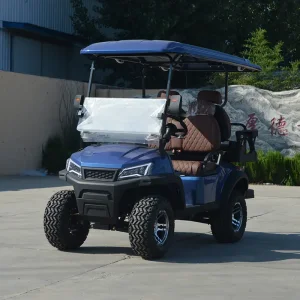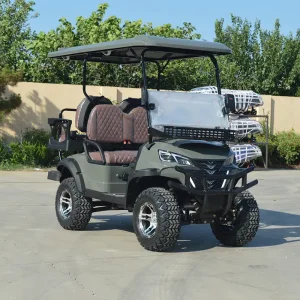
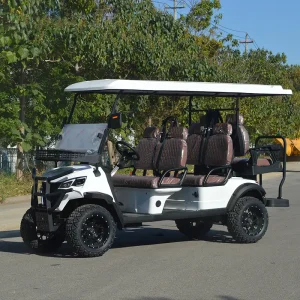
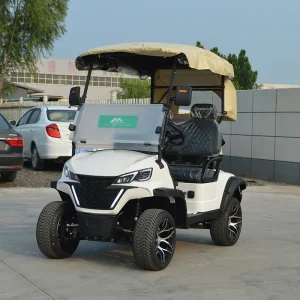
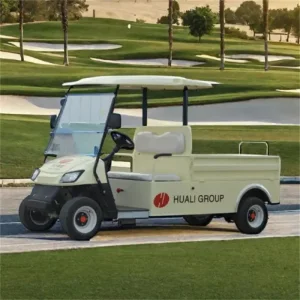
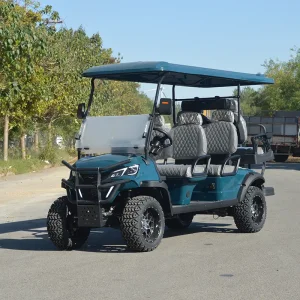
Flagship Commercial & Utility Golf Vehicles
Explore our premium core lineup engineered with automotive-grade robotic welding, 72V/48V high-torque powertrains, and customized ODM export packages.
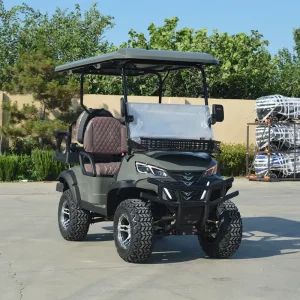
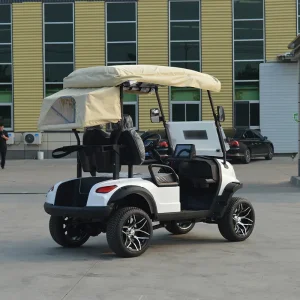
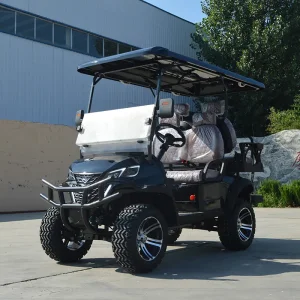
The Single-Rider Revolution: Transforming Golf Course Operations
A rigorous operational evaluation on how single-rider electric golf carts (SR-EGCs) enhance tee-sheet velocity, conserve course agronomy, and reduce total cost of fleet ownership.
Executive Thesis: The modern golf course business model faces a dual imperative: accelerating pace-of-play while reducing agronomic degradation caused by heavy, multi-passenger utility carts. Traditional four-wheel, two-passenger golf carts impart ground contact pressures ranging from 12 to 18 PSI, shearing delicate bentgrass fairways and creating compaction zones that demand expensive aeration.
As an original design manufacturer (ODM) with over 20 years of precision vehicle engineering, our factory engineered the dedicated single-rider electric golf cart to operate at a featherweight footprint—under 6.5 PSI—while slashing average round completion times from 4 hours 15 minutes down to under 2 hours 45 minutes.
Pace of Play Optimization
Multi-passenger carts inherently create operational bottlenecks: players must drive to Ball A, wait, and then drive cross-fairway to Ball B. Single-rider carts enable true parallel routing, where every golfer drives directly to their own ball, completely eliminating zig-zag travel and reclaiming valuable tee intervals.
Zero Turf Shearing Agronomy
Engineered with articulated steering geometry and low-pressure ultra-wide turf flotation tires, our single-rider vehicles distribute vehicle weight evenly. The reduced curb weight (165 kg vs. 480 kg of standard 2-seaters) ensures play continuation even in 90-degree wet turf conditions without track ruts.
Inclusive & ADA Fleet Compatibility
Our single-rider chassis architecture can be outfitted with 360-degree swivel seating, hand-throttle drive controls, and adaptive bag caddie holsters, enabling golf courses to seamlessly meet ADA accessibility standards while offering an exhilarating individual riding experience for modern golf demographics.
Integrated Chinese Factory Supply Chain Advantage
Direct from our 13,000 m² advanced automotive manufacturing facility in Dezhou, Shandong—delivering structural integrity, localized engineering, and direct-to-consumer pricing agility.
Robotic Chassis Fixturing
High-tensile tubular steel chassis welded using fully automated robotic fixtures. Treated via progressive multi-stage cathodic electrophoretic dipping (E-coat) to withstand coastal sea spray and humid tropical resort environments.
Tier-1 LiFePO4 Chemistry
Integrated with Grade-A automotive Lithium Iron Phosphate (LiFePO4) cell arrays and smart CAN-bus battery management systems (BMS) with real-time temperature, overvoltage, and cell balancing telemetry.
Complete ODM Modular Customization
Full-spectrum engineering adaptation: custom bodywork tooling, thermoformed ABS/PP fairings, integrated beverage chillers, golf bag quick-clamps, client-branded digital LCD consoles, and solar trickle-charging roofs.
High-Density Container Logistics
Optimized nesting and modular wheel/handlebar assembly geometry allows loading up to 48 single-rider units per 40ft HQ shipping container—dramatically slashing per-unit oceanic freight overhead for overseas distributors.
Engineering Specifications: Single-Rider vs. Traditional Carts
A data-backed comparison highlighting performance, ecological impact, and fleet operational economics.
| Evaluation Parameter | ODM Single-Rider Electric Cart | Standard 2-Seater Golf Cart | Heavy 4-Seater Resort Buggy |
|---|---|---|---|
| Curb Weight (w/ Lithium Pack) | 145 – 185 kg | 380 – 460 kg | 540 – 680 kg |
| Turf Contact Pressure (PSI) | 5.5 – 6.8 PSI | 12.5 – 16.0 PSI | 18.0 – 24.0 PSI |
| Pace of Play (18 Holes / Group) | 2 hrs 30 mins – 2 hrs 50 mins | 4 hrs 10 mins – 4 hrs 40 mins | 4 hrs 45 mins + |
| Powertrain Voltage & Motor | 48V / 60V / 72V Brushless AC (1.5kW - 3kW) | 48V DC/AC (3kW - 4kW) | 72V AC High-Torque (5kW - 7.5kW) |
| Energy Consumption per 18 Holes | 0.85 – 1.2 kWh | 2.4 – 3.2 kWh | 4.5 – 6.0 kWh |
| 40ft HQ Container Capacity (SKD) | 42 – 48 Units | 18 – 22 Units | 8 – 12 Units |
| Wet Weather Course Access | Permitted (Low compaction index) | Restricted (Path only) | Strictly Prohibited |
Regulatory Homologation & Safety Architecture
Built to satisfy international low-speed vehicle standards across North America, the European Union, Australia, and the Middle East.
North American LSV & FMVSS 500
Engineered to comply with United States Department of Transportation (DOT) National Highway Traffic Safety Administration (NHTSA) FMVSS Part 571.500 standards. Equipped with reflex reflectors, DOT-stamped acrylic windshields, parking brakes capable of 20% slope holding, and SAE-compliant LED lighting packages.
European Union L6e / CE Directives
Fully compliant with EU Machinery Directive 2006/42/EC and Electromagnetic Compatibility (EMC) Directive 2014/30/EU. Optional homologation preparation for L6e-A light quadricycles, including dual-circuit regenerative hydraulic disc brakes, horn decibel attenuation, and CE-marked electronic control modules.
UN38.3 & UL Battery Fire Safety
Every lithium battery sub-assembly passes strict UN38.3 vibration, thermal shock, altitude simulation, and short-circuit testing protocols. Pack casing is constructed from IP67 flame-retardant aluminum enclosures featuring autonomous aerosol thermal-runaway mitigation units.
Versatile Deployment Profiles for Global Enterprises
Beyond traditional golf club tee-sheets, our single-rider electric buggies empower modern multi-sector commercial mobility needs.
Gated Residential Communities & Master-Planned Estates
Single-rider low-speed vehicles offer seniors and active adults independent transit across pedestrian-dense private master-planned communities, retirement villages, and luxury residential estates with zero exhaust and ultra-quiet motor hum.
Industrial Campus & Airport Maintenance Patrol
High-efficiency individual transit for facility directors, security personnel, and technicians navigating sprawling automotive plants, mega-warehouses, aerospace complexes, and international airport tarmac corridors.
Eco-Tourism, Vineyards & Glamping Resorts
High-end eco-resorts utilize single-rider buggy fleets to provide guests with autonomous, immersive trail exploration across vineyards, botanical reserves, and off-grid mountain luxury retreats without disrupting wilderness silence.
Frequently Asked Questions by Commercial Buyers
Technical, logistical, and warranty inquiries answered directly by our senior vehicle manufacturing engineering team.
What are the key technical distinctions between single-rider and standard multi-seat golf carts?
Can your factory provide bespoke OEM/ODM custom branding and mechanical adaptations?
What battery chemistries are available and what is the expected lifespan in high-heat climates?
What is the Minimum Order Quantity (MOQ) and sample lead time for global distributors?
How does your factory manage warranty claims and international spare parts supply?
Specialized Utility, Sightseeing & Extended Buggies
Complete your fleet with our high-capacity commercial platforms, multi-seat passenger shuttles, and solar-assisted recreational vehicles.