
High-Efficiency Commercial Fleet & Personal Mobility Units
Explore our export-ready models engineered with certified LiFePO4 battery architectures, automotive-grade chassis, and intelligent energy management systems.






Macro Industry Landscape: The Micro-Mobility & Standing EV Revolution
Decarbonization mandates, golf course modernization, and industrial warehousing logistics are triggering a worldwide shift toward single-rider, agile standing golf carts and multi-passenger low-speed utility electric vehicles.
Pace-of-Play & Course Economics
Traditional 2-seat and 4-seat golf carts restrict players to shared routes, exacerbating turf wear along fairway margins and slowing average 18-hole rounds to over 4.5 hours. Commercial standing electric golf carts and personal turf runners empower golfers to navigate directly to their ball, trimming round durations by up to 35% while distributing ground surface pressure evenly.
- Sub-10 PSI turf-friendly low ground pressure footprint
- Higher daily turnover capacity per 18 holes
Total Cost of Ownership (TCO) Metrics
From an enterprise asset-management standpoint, standing golf carts and modular low-speed vehicles (LSVs) significantly slash maintenance downtime. Equipped with automotive LiFePO4 battery modules and intelligent BMS, fleet operators eliminate acid watering, terminal degradation, and parasitic draw, cutting multi-year maintenance operational budgets by more than 40%.
- 3,500+ lifecycle recharge cycles with active thermal BMS
- Substantial reduction in unladen vehicle weight
Industrial Intra-Facility Logistics
The application envelope for electric standing and micro-utility vehicles extends well beyond green fairways. Global manufacturing compounds, aviation terminals, mega-resorts, and maritime ports deploy standing electric carts for security patrols, supervisory inspections, and rapid component delivery, where rapid step-on/step-off ingress accelerates job throughput.
- Zero emissions inside enclosed logistics warehouses
- Ultra-tight turning radius for narrow aisle navigation
Engineering Consensus: Modern OEM electric standing golf cart architecture combines leaning suspension mechanics, low-center-of-gravity ballast layouts, and torque-vectoring controllers to achieve dynamic high-speed stability without compromising natural turf preservation.
End-to-End OEM & ODM Manufacturing Ecosystem
Dezhou Leibin Vehicle Industry operates complete in-house manufacturing units covering laser chassis cutting, robotic welding, cathodic electrodeposition coating, powertrain integration, and digital road testing.
| Subsystem Component | OEM Standard Specification | Customizable ODM Upgrades | Fleet Operational Benefit |
|---|---|---|---|
| Chassis & Subframe | High-tensile tubular steel / Q235B stamped robotically | Aviation-grade 6061-T6 Extruded Aluminum alloy | 35% weight reduction; complete salt-fog coastal rust immunity |
| Powertrain Propulsion | 48V / 72V Brushless AC Induction Motor (4.0kW to 7.5kW) | PMSM (Permanent Magnet Synchronous) with regenerative braking | 94% peak energy efficiency; maintenance-free brushless operation |
| Energy Storage System | Automotive LiFePO4 Battery Pack (51.2V / 76.8V 105Ah) | High-density NMC or expandable 210Ah LiFePO4 packs | 80-120 km continuous range per charge; 2-hour fast recharge |
| Suspension & Steering | Independent MacPherson struts + rear trailing arm dampening | Dynamic hydraulic leaning suspension with tilt-lock mechanism | Prevents rollover during sharp banking turns on hills and slopes |
| Fleet IoT & Telematics | CAN-bus digital instrument cluster & keyless ignition | 4G/GPS fleet geofencing, remote lock, battery telemetry API | Centralized fleet control; instant unauthorized perimeter geofence alerts |
CAD & Digital Twin
Parametric 3D structural modeling, FEA stress simulation, and ergonomics verification for standing & seated operators.
Robotic Prototyping
Jig-fixtured robotic arm welding and 16-stage cathodic electrocoating (e-coat) ensuring 1000+ hour salt-spray endurance.
Powertrain Calibration
Dynamometer torque tuning, BMS overvoltage/temperature balance calibration, and gradeability incline torture testing.
Homologation & Crated Export
Full CE, ISO9001, and FMVSS 500 compliance verification packed in modular steel-caged SKD/CKD shipping structures.
Engineered for High-Density Micro-Mobility Scenarios
Whether navigating rolling links fairways or sprawling industrial manufacturing perimeters, our standing electric carts and multi-seat low-speed vehicles outperform traditional platforms.
Championship Golf & Links Courses
Standing golf carts unlock rapid single-player mobility. With low unsprung weight and wide high-flotation turf tires, players bypass 90-degree cart path restrictions and drive directly across fairways on dew-laden mornings without damaging fine bentgrass or leaving heavy tire ruts.
- Dual caddie bag mounting brackets with magnetic quick-latches
- Electronic regenerative hill holding on steep undulations
Eco-Resorts & Master-Planned Communities
Luxury resort estates and coastal hospitality villages demand silent, zero-emission transportation that blends seamlessly into pristine natural environments. Custom branded color palettes, solar charging canopies, and whisper-quiet AC drivetrains elevate guest satisfaction scores.
- Solar trickle-charge roofs generating up to 25% supplementary daily range
- Marine-grade upholstery resistant to UV exposure and sea spray
Industrial Compounds & Security Patrols
For factory plant supervisors, security personnel, and distribution logistics crews, standing micro-vehicles provide an elevated vantage point for superior situational awareness. Workers can step on and dismount instantly without wrestling with seatbelts or doors during multi-stop shift routines.
- Integrated strobe beacon mounts, sirens, and tool utility bins
- Tight 2.4m turning radius for indoor warehouse and hangar navigation
Global Homologation & Localized Support Infrastructure
Importing fleet vehicles requires comprehensive alignment with local road safety authorities, electrical standards, and supply chain logistics. Leibin offers turn-key compliance documentation.
North America: FMVSS 500 & SAE J2358
For US Low-Speed Vehicle (LSV) classification and Canadian CMVSS compliance, models are configured with DOT-approved AS4 laminated glass windshields with wipers, DOT-rated tires, 3-point seat restraints, rear-view backup cameras, audible pedestrian warning systems, and factory-governed 25 mph speed ceiling controllers.
European Union: EEC L6e / L7e Directives
Our European export configurations meet strict UNECE type-approvals, incorporating E-mark certified LED headlamps and mirrors, dual-circuit hydraulic disc brakes, mechanical hand parking locks, CE machinery directives, and UN38.3 battery transport safety documentation.
CKD / SKD Optimized Global Logistics
To slash international maritime shipping rates and import customs duties, Leibin provides bespoke steel-bracket packaging. We engineer CKD (Complete Knock Down) and SKD (Semi Knock Down) loading layouts that maximize container pack density—fitting up to 24 standing golf cart units inside a standard 40-foot High Cube ocean container.
Technology Roadmap: The Autonomous & Connected Horizon
The boundary between low-speed vehicles and smart robotics is blurring. Our R&D division in Dezhou is actively pioneering technologies that will define golf cart and standing utility operations through 2030.
LiDAR & Vision-Based "Follow-Me" Caddies
Next-generation electric standing golf carts feature ultra-wideband (UWB) beacon tracking paired with solid-state LiDAR sensors. Golfers can either ride standing or walk unencumbered while their cart autonomously tracks behind them at a safe 2-meter follow buffer, avoiding water hazards and sand bunkers.
Solid-State Battery & Bidirectional V2G Integration
Moving toward quasi-solid-state electrolyte cells, future golf cart fleets will achieve energy densities exceeding 280 Wh/kg, offering true sub-zero operating capability without thermal loss. When docked in clubhouses, bidirectional chargers allow fleets to shave peak utility grid surcharges via V2B (Vehicle-to-Building) power back-feeding.
Cloud-Linked Predictive Maintenance Telematics
Embedded 5G IoT controllers stream real-time cell impedance, controller thermal spikes, and motor brush phase current directly to a fleet manager dashboard. Cloud AI algorithms flag motor bearing wear or tire underinflation days before an on-course mechanical failure occurs.
Frequently Asked Questions on OEM Electric Standing Golf Carts
Essential guidance for resort procurement managers, commercial distributors, and golf course fleet directors looking to partner with China's premier manufacturer.
What is the primary operational advantage of standing golf carts vs seated carts?
Standing electric golf carts provide dramatic improvements in game speed (pace-of-play) because players travel independently to their own ball rather than waiting for a partner. Additionally, their lightweight footprint (typically 60-70% lighter than standard 4-seater carts) substantially mitigates soil compaction and turf root damage, enabling courses to allow play even on damp, restricted-cart fairway conditions.
Why should fleet operators mandate 72V Lithium over traditional 48V Lead-Acid?
A 72V architecture draws substantially lower amperage than a 48V system to produce equivalent torque, leading to significantly reduced thermal buildup in motor windings and motor controllers. Paired with LiFePO4 cells, 72V powertrains conquer steep 25%+ gradients effortlessly, eliminate toxic battery acid maintenance, charge in under 3 hours, and deliver over 8 years of daily duty cycle longevity.
What are your Minimum Order Quantities (MOQ) and lead times for OEM branding?
For standard models, our factory accepts sample evaluation orders of 1 to 2 units. For full OEM custom branding (custom paint codes, customized mold badges, personalized seat embroidery, and proprietary controller parameter tuning), our standard baseline MOQ is a single 20-foot or 40-foot shipping container. Average factory lead time is 20 to 30 days from engineering signoff.
How does Leibin guarantee spare parts availability and after-sales service globally?
Every commercial export order includes a complimentary essential wear-and-tear replacement package (brake pads, relays, bushings, fuses). Furthermore, we maintain a centralized international replacement depot with DHL/FedEx courier dispatch for controllers, chargers, and suspension hardware. Full schematics, interactive CAD wiring maps, and direct engineer video troubleshooting are standard with every contract.
Can your electric standing golf carts be configured for street-legal LSV use?
Yes. We can factory-configure the vehicles with FMVSS 500 / DOT or EEC L6e homologation packages. This incorporates dual illuminated side-view mirrors, AS4 shatter-proof laminated glass windshields, horn, high/low beam headlights, turn signals, hazard lights, emergency brake locks, and calibrated digital speedometers restricted to local legal low-speed velocity ceilings (typically 25 mph or 40 km/h).
What safety features protect operators during high-speed turns on standing carts?
Our standing golf carts integrate active dynamic stability systems. These include electronic steering-angle velocity limiters (which automatically reduce drive torque when steering lock exceeds 15 degrees), wide non-slip standing floorboards with dual vibration dampeners, low-slung underslung battery chassis ballast, and front-to-rear hydraulic disc braking that eliminates rear-wheel skid.
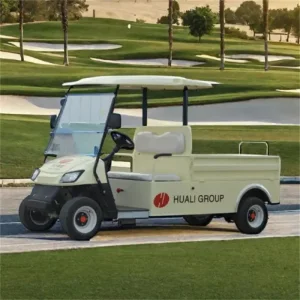
Featured Fleet Vehicles & Multi-Passenger Shuttles
From compact personal runabouts to high-capacity 6-seater estate transporters, Leibin provides factory-direct wholesale pricing backed by comprehensive warranties.

