
Industrial High-Mobility Inspection & Rapid-Deployment Units
Discover factory-direct low-speed electric patrol chassis, solar-assisted surveillance vehicles, and rapid-response buggies ready for turnkey international fleet dispatch.
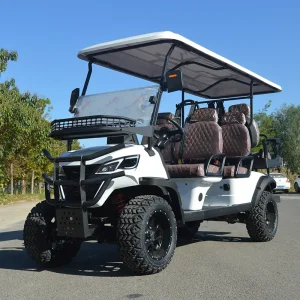
The Transformation from Static CCTV to Mobile Electric Surveillance Fleets
How zero-emission electric mobility platforms, integrated solar harvesting, and high-payload telescopic sensor masts are redefining critical perimeter protection.
Closing the "Dead-Zone" Vulnerability with Dynamic Mobility
Traditional perimeter protection relying on fixed camera towers frequently leaves security teams blind to transient blind spots, environmental obstructions, and evolving trespass corridors. Installing trenched fiber-optic cables and high-voltage grid connections across expansive solar installations, oil refineries, and industrial complexes often costs upwards of $120,000 per linear kilometer. Mobile electric surveillance vehicles eliminate this infrastructural barrier entirely.
By combining high-energy-density 72V Lithium Iron Phosphate (LiFePO4) powertrains with pneumatic telescopic masts that elevate dual-sensor optical/thermal PTZ arrays up to 6 meters, our factory-built mobile units act as self-contained, mobile Command and Control (C2) outposts. Security staff can patrol actively at 25–40 km/h or deploy silently on static waypoint vigilance for up to 72 continuous hours using integrated high-yield monocrystalline solar roofs.
Operational Efficiency Metrics
Comparative performance analysis indicates a 68% reduction in rapid incident-response times when replacing walking guards or static CCTV with mobile patrol carts equipped with on-board edge intelligence.
Why Global Security Fleets Source from our Dezhou Manufacturing Hub
From raw tubular steel fabrication and robotic welding to robotic immersion electrophoretic deposition (ED) coating, our vertically integrated plant controls every tier of production quality.
High-Yield Steel & Robotic Welding
Unlike regional assemblers reliant on outsourced bolted frames, our factory features dedicated CNC mandrel bending and robotic jig-fixtured welding bays. Every mobile surveillance and patrol chassis utilizes Q235B micro-alloyed structural tubular steel, engineered to maintain torsional rigidity across jagged off-road topographies while carrying auxiliary battery reserves and telescopic sensor rigs.
LiFePO4 Integration & Intelligent BMS
We source Tier-1 lithium prismatic cells directly from top-tier domestic supply chains, packaging them into localized 48V and 72V packs with integrated CAN-bus Battery Management Systems (BMS). Our architecture prevents thermal runaway, delivers over 3,500 full charge cycles at 80% DOD, and allows seamless hybrid DC-to-DC conversion to power 12V/24V/48V PoE camera payloads without noisy inverters.
Unrivaled Turnkey Cost Leadership
By producing chassis frames, body injection panels, suspension linkages, and drive harnesses under one 13,000 m² plant in Shandong, our procurement partners achieve 35% to 50% cost reductions compared to Western branded equivalents, without compromising on high-spec components like Curtis controllers and KDS AC asynchronous traction motors.
Total Cost of Ownership (TCO) vs. Conventional Diesel Generators
A detailed financial and logistical analysis for corporate purchasing committees, defense contractors, and municipal facility operators.
| Evaluation Parameter | Diesel Generator Surveillance Trailer | Leibin 72V Lithium Electric Mobile Surveillance Unit |
|---|---|---|
| Direct Energy & Fuel Expense | $18.50 - $26.00 per 24hr operating cycle (Diesel @ $3.80/gal) | $1.20 - $2.40 per full recharge (Free supplemental solar input) |
| Acoustic & Thermal Footprint | 65 - 78 dB audible engine drone; distinct thermal signature | Near-Zero Acoustic Output (< 25 dB); low thermal signature |
| Preventive Maintenance Cycle | 250 operating hours (Oil, filters, belt replacements, fuel filters) | Maintenance-free solid-state LiFePO4; annual mechanical inspection |
| Mobilization & Deployment Speed | Requires secondary tow vehicle, hitch alignment, manual outriggers | Self-propelled electric drive; reposition within seconds via driver or remote |
| 5-Year Operational Expenditure (Opex) | $38,000 - $52,000 per tower deployment | $4,200 - $6,500 total estimated lifecycle expense |
| Carbon Offset Compliance | Emits ~12.8 metric tons CO2 per continuous operating year | True Zero tailpipe emissions (Qualifies for ESG tax subsidies) |
International Regulatory Standards & Localization Support
Navigating regional low-speed vehicle (LSV) road standards, cyber-security directives, and radio frequency homologation across global jurisdictions.
Road Homologation: FMVSS 500 & EEC L6e/L7e
For operations extending into public thoroughfares, campus crossings, and municipal roads, our engineering division configures DOT-certified automotive glass windshields with wipers, DOT-stamped tires, three-point inertia-reel seatbelts, illuminated rearview mirrors, side turn indicators, dual-circuit hydraulic disc brakes, and electronic speed limiters set strictly to local 25 mph (40 km/h) mandates.
Cyber-Secure & NDAA-Compliant Payloads
To support high-security installations, government borders, and critical defense contractors, Leibin offers customizable payload architectures. We integrate NDAA-compliant SOC processors (Ambarella, Qualcomm), Western optic sensors, and encrypted dual-SIM 4G/5G edge routers compliant with FCC Part 15 and CE RED (Radio Equipment Directive) standards to guarantee zero data-exfiltration risks.
SKD / CKD Global Logistics Packaging
To reduce import tariffs and ocean freight costs, we provide engineered Semi-Knocked Down (SKD) and Completely Knocked Down (CKD) crating solutions. Every shipment includes step-by-step assembly jigs, digitized color-coded wiring schematics, and high-tensile steel container racking systems capable of nesting up to 18 complete buggy units per 40ft HQ shipping container.
Mission-Critical Deployment Scenarios
Engineered to excel in demanding environmental conditions, from arid high-heat perimeters to humid maritime installations.
Utility-Scale Solar Farms & Critical Infrastructure
Remote photovoltaic arrays and wind farms span thousands of acres with minimal physical presence. Our 72V lithium surveillance carts traverse unimproved gravel roads with 25% incline gradeability. Outfitted with 30x optical zoom PTZ cameras and long-wave infrared (LWIR) sensors, a single vehicle detects thermal variations on solar panels and flags fence line intrusions from up to 1.5 kilometers away.
Maritime Ports, Logistics Hubs & Industrial Complexes
Industrial intermodal hubs suffer from constant blind spots created by moving container stacks. Electric surveillance buggies move dynamically between crane tracks and logistics lanes without generating noxious diesel fumes inside covered storage buildings. With electrophoretic chassis protection resisting salt-spray corrosion, these units endure harsh seaside conditions year after year.
Large-Scale Events, Conventions & VIP Escort
For music festivals, sports arenas, and international summits, large noisy security vehicles disrupt patrons and pose pedestrian hazards. Our quiet electric platforms provide visible security deterrence, whisper-quiet transit, emergency public-address (PA) speaker capability, and on-board high-intensity strobe lighting without disturbing attendees or generating dangerous fumes in crowd zones.
Border Crossings & Remote Perimeter Security
Where harsh borders separate sovereign territories or secure enclaves, our off-road G80 and G90 platforms offer specialized high-ground clearance, all-terrain beadlock tires, and solar auxiliary trickle-charging. Patrol teams can conduct silent overnight stakeouts, leveraging on-board battery power to maintain high-gain radio telemetry and infrared recording without running an engine.
Next-Generation Trends in Electric Mobile Surveillance
How the convergence of AI edge computing, autonomous navigation, and intelligent microgrids is transforming the next generation of security vehicles.
Edge Vision AI & Real-Time Classification
The industry is migrating from passive video transmission to localized edge inference. Modern surveillance platforms process video streams directly inside the vehicle using ultra-low-power NPU microcomputers. Neural networks execute real-time human detection, License Plate Recognition (ALPR/ANPR), abandoned object classification, and thermal boundary breaches, sending ultra-compressed alarm vectors via satellite or cellular uplinks.
Bifacial Solar Microgeneration Integration
Next-gen roof structures now incorporate high-efficiency bifacial monocrystalline solar cells engineered directly into curved automotive roofs. Capable of harvesting light from direct sunlight as well as ground albedo reflection, these solar generators yield up to 450W of continuous charging output, extending patrol ranges by 15–25 km daily or indefinitely sustaining static camera telemetry in sunny climates.
Autonomous Waypoint & RTK Drive-By-Wire
Leibin's R&D team is piloting drive-by-wire chassis equipped with CAN-bus steering actuators, electro-hydraulic brake controllers, and RTK-GNSS dual-antenna centimeter-level localization. This architecture allows patrol buggies to switch between manned security driving and fully automated scheduled route sweeps, drastically reducing human security payroll requirements.
Frequently Asked Questions for Fleet Importers
Everything corporate buyers need to know regarding battery longevity, payload configuration, shipping volumes, and custom OEM manufacturing.
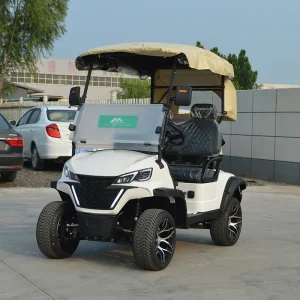
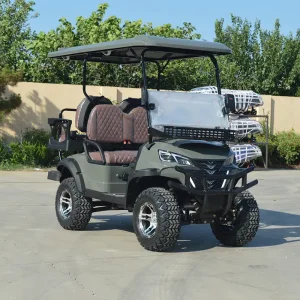
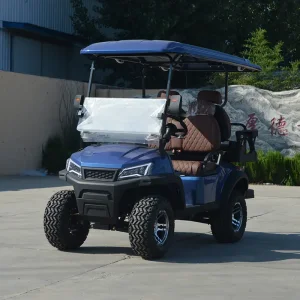
Enterprise Low-Speed Sightseeing & Patrol Product Lineup
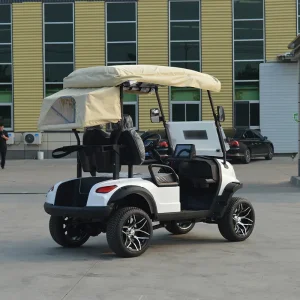
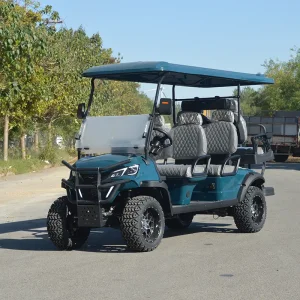
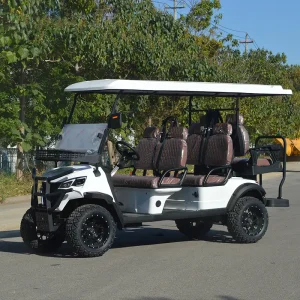
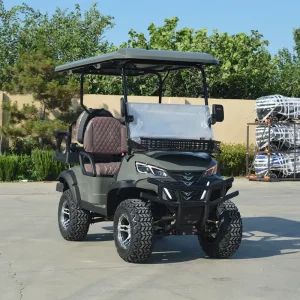
Compare our heavy-duty 2-seater, 4-seater, and 6-seater multi-role electric utility models directly from the assembly line.
Consult Directly with a Leibin Fleet Powertrain Engineer
Request comprehensive CAD dimensional drawings, custom telescopic mast integration options, container packing plans, and FOB/CIF wholesale price quotes.